





Meet the Roman Space Telescope
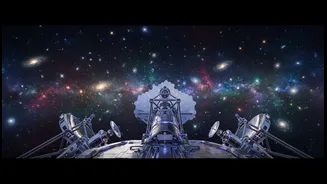
Set to launch by mid-2027, NASA’s Nancy Grace Roman Space Telescope is the next great observatory in the tradition of Hubble and the James Webb Space Telescope (JWST). But while its predecessors are designed for deep, focused dives on specific cosmic
targets, Roman is built for speed and scale. Its primary mirror is the same size as Hubble's, but its Wide Field Instrument gives it a viewing area over 100 times larger. This panoramic view will allow it to map huge swaths of the sky with incredible speed and precision, creating cosmic panoramas that would take Hubble centuries to complete. Scientists expect the mission to discover a staggering number of new worlds—potentially around 100,000 exoplanets. This represents a monumental leap from the roughly 6,300 confirmed to date.
Einstein's Secret Weapon: Microlensing
So, how will Roman find planets that are too far away for other methods? Its main technique relies on a fascinating phenomenon predicted by Albert Einstein called gravitational microlensing. This method doesn't depend on seeing the faint light from a planet itself. Instead, it watches for the moment when a star with a planet passes perfectly in front of a much more distant, background star. The gravity of the foreground star acts like a lens, bending and magnifying the light of the star behind it, causing a temporary and predictable spike in brightness. If that foreground star has a planet, the planet’s own gravity adds a second, smaller lensing effect—a brief, extra flicker of light. By detecting these tiny, tell-tale flickers, Roman can find planets thousands of light-years away, even down to the mass of Earth.
A New Galactic Census
Conventional methods, like the 'transit' method used by the Kepler and TESS missions, work best for planets that are relatively close to us and orbit their stars tightly. These methods look for the tiny dip in a star's light as a planet passes in front of it. This makes it difficult to find planets that are far from their stars or located deep in the dense, star-filled center of our galaxy. Roman’s microlensing survey, however, excels in these exact areas. It will primarily search the Milky Way's central bulge, a region teeming with stars but previously difficult to survey for planets. This will allow astronomers to conduct a galactic census, finding worlds in orbits similar to those of planets in our own solar system and even discovering 'rogue' planets that wander through space without a host star.
Working in Tandem with Webb
Roman is not a replacement for the James Webb Space Telescope but a powerful partner. Think of Roman as a wide-angle lens and Webb as a telephoto lens. Roman will survey huge areas, identifying tens of thousands of fascinating targets, from unique exoplanets to distant black holes. Webb, with its unparalleled sensitivity and deep-seeing infrared capabilities, can then perform detailed follow-up observations on the most interesting discoveries Roman makes. For instance, Roman may find a potentially habitable world far away, and Webb could then be tasked to study its atmosphere in detail. This synergy will give us the most complete picture of the universe yet, combining Roman's vast surveys with Webb's deep, focused gaze.