

Cosmic Construction Zones
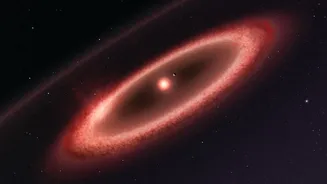
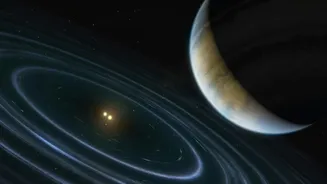
Imagine a cosmic construction zone, impossibly vast and swirling with raw materials. These are protoplanetary disks—enormous, pancake-shaped clouds of gas and dust that surround young stars. It is within these dense, chaotic environments that planets
are born. Microscopic dust particles, composed of elements like carbon and silicates, begin to clump together. Over millions of years, these clumps grow from tiny grains into pebbles, then planetesimals—the building blocks of planets—and eventually into full-fledged worlds like Jupiter or even Earth. These disks are where the story of every planet begins, but for a long time, the crucial first chapters of that story remained unreadable.
A Veil of Dust
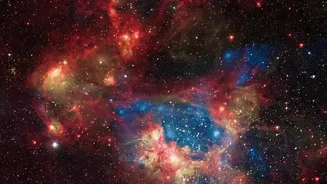
The very same dust that builds planets has long been an obstacle for astronomers. These dense clouds are opaque, meaning they block and scatter visible light—the kind our eyes and telescopes like the Hubble Space Telescope primarily see. Peering into a stellar nursery with a visible-light telescope is like trying to watch a stage performance through a thick, dark curtain. You can see the glow from behind, but the action itself is completely obscured. This has left a frustrating gap in our understanding of planet formation; we knew where it was happening, but we couldn't watch the process unfold. To see inside, we needed a different kind of vision.
Webb’s Infrared Superpower
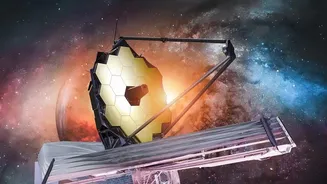
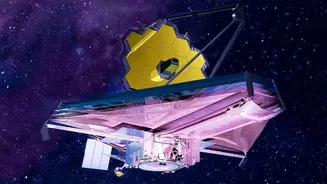
This is where the James Webb Space Telescope (JWST) changes the game. Webb is a specialist, designed to see the universe in infrared light. Infrared is a wavelength of light that is invisible to human eyes but which we can feel as heat. Crucially, infrared light has a longer wavelength than visible light, allowing it to pass through clouds of gas and dust that would otherwise be impenetrable. Think of it like the difference between smoke and a thermal camera; while you can't see a person through thick smoke, a thermal camera can easily detect their heat signature. By detecting these faint heat signals, Webb effectively lifts the cosmic curtain, transforming opaque dust clouds into transparent windows.
The Right Tools for the Job
Webb accomplishes this feat using a suite of powerful instruments, chief among them the Near-Infrared Camera (NIRCam) and the Mid-Infrared Instrument (MIRI). These two instruments work in tandem to provide a complete picture. NIRCam captures shorter infrared wavelengths, excelling at imaging the hotter, denser regions closer to a young star. MIRI, which must be kept incredibly cold to function, detects longer, mid-infrared wavelengths. This makes it exceptionally good at seeing the faint glow of cooler, more spread-out dust and identifying the chemical makeup of the disk, including water, carbon dioxide, and other molecules crucial for life. Together, they allow astronomers not just to see through the dust, but to analyze it.
Unveiling Planetary Blueprints
What Webb is revealing is nothing short of revolutionary. In images of protoplanetary disks like the one around the star HL Tauri, astronomers can now see distinct gaps and rings within the dust. These features are strong evidence of young planets carving paths through the disk as they orbit, sweeping up material. Webb's spectroscopic abilities also allow scientists to take a chemical census of these planet-forming regions, mapping the distribution of water ice, carbon, and complex organic molecules—the very ingredients needed for planets and, potentially, life. It is also revealing that the window for planet formation might be more complex and varied than previously thought, with some disks lasting much longer than expected.
A Window to Our Own Past
By studying these distant, infant solar systems, we are also learning about our own origins. Each protoplanetary disk Webb observes is like a snapshot from the early history of a solar system, giving us a glimpse of what our own neighborhood might have looked like 4.6 billion years ago. The processes we see unfolding hundreds of light-years away—dust turning into rock, gaps forming in disks, and the delivery of water to inner regions—are the same processes that eventually led to the formation of Earth. For the first time, we are not just theorizing about how our world came to be; thanks to Webb’s infrared eyes, we are watching it happen elsewhere in the galaxy.