









The Old Picture of the Cosmos
For decades, the prevailing theory of cosmic evolution painted a simple picture of the early universe. Shortly after the Big Bang, the first galaxies were thought to be small, chaotic, and clumpy messes. Astronomers believed these infant galaxies were dominated
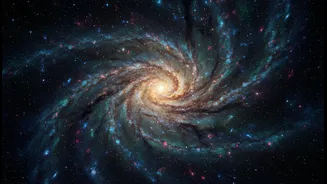
by intense but disorganized bursts of star formation and frequent, messy mergers. The elegant, structured galaxies we see today, like our own spiral Milky Way, were considered late bloomers. It was assumed they needed billions of years of calm, steady evolution to develop features like rotating discs, stellar bars, and spiral arms. The early universe was seen as a turbulent nursery, not a place for well-organized galactic architecture.
A Sharper, Deeper Look
That long-held picture is now being dramatically redrawn, thanks to the unparalleled power of the James Webb Space Telescope (JWST). With its large mirror and extreme sensitivity to infrared light, JWST can peer deeper into space and further back in time than any previous observatory, giving us our clearest view yet of the cosmic dawn. Recent studies, including one from Durham University and another from India's Inter-University Centre for Astronomy and Astrophysics (IUCAA), have used JWST data to challenge the old models. These studies reveal that galaxies were becoming organized much sooner after the Big Bang than anyone expected.
What 'Complex' Really Means
So, what does it mean for an ancient galaxy to be 'complex'? It means they show signs of maturity and structure that were believed to be impossible so early on. One major discovery is the presence of nuclear discs—dense, rotating structures of stars at the very center of galaxies. Researchers found the earliest known example of such a disc in a galaxy seen as it was just 4.5 billion years after the Big Bang, a structure previously seen only in much older, nearby galaxies. Another key feature is the stellar bar, a long structure of stars that acts like a cosmic conveyor belt, funnelling gas to the galaxy's center and fuelling star formation. Finding these bars and discs means that the processes that build organized galaxies were already at work when the universe was just a fraction of its current age.
Rewriting Cosmic History
These findings are more than just cosmic trivia; they force a fundamental update to our theories of galaxy formation. The evidence suggests that galaxies evolved in a structured and efficient way just a few billion years after the Big Bang. The IUCAA team found that even galaxies from the first billion years of the universe followed the 'Kormendy relation,' a rule linking a galaxy's brightness to its size, which was previously only confirmed for modern galaxies. This implies the basic physics that shape galaxies today were already in place in the universe's infancy. This rapid maturation also has profound implications for how quickly supermassive black holes could grow, as organized structures like bars and discs are excellent at funnelling fuel towards a galaxy's central black hole.