



The Inevitable Pull of Gravity
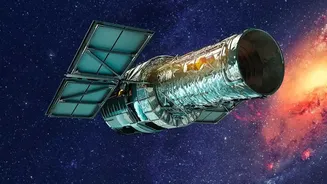
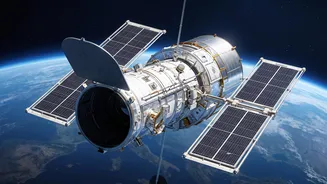
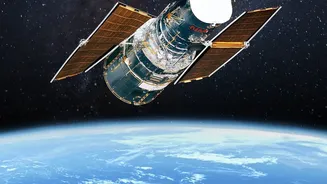
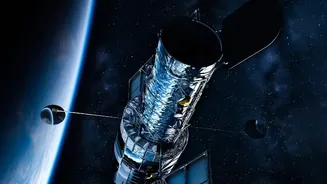
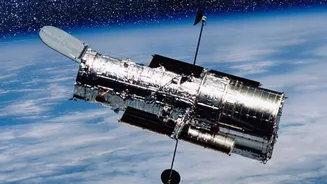
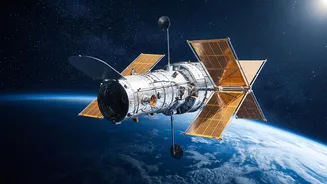
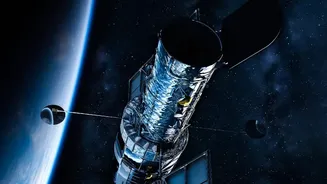
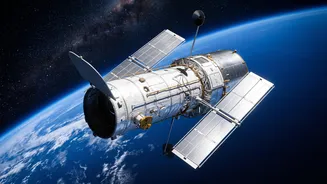
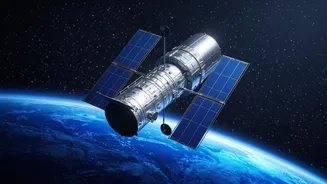
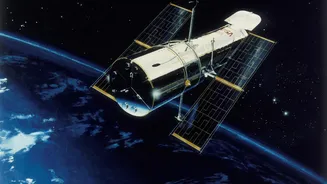
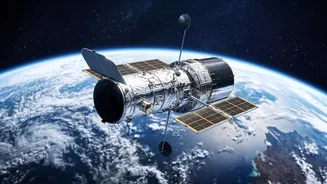
Hubble has no engine to keep its orbit stable. Since its last service mission in 2009, its altitude has been steadily decreasing. Though it orbits hundreds of kilometres up, there's still a whisper of Earth's atmosphere creating tiny amounts of drag on the school
bus-sized observatory. This atmospheric drag acts like a constant, gentle brake, pulling Hubble closer to Earth. The rate of this decay isn't constant; it increases when the Sun is more active, causing the upper atmosphere to swell and become denser. Current estimates show the telescope's altitude is decreasing by over 14 kilometres per year, and without intervention, it is projected to make an uncontrolled reentry into the atmosphere sometime in the mid-2030s.
Option 1: A Simple Push
The most straightforward solution being considered is an orbital boost. This would involve a robotic or possibly crewed spacecraft visiting Hubble, docking with it, and firing its own thrusters to push the telescope into a higher, more stable orbit. NASA has formally asked the private space sector for ideas on how to achieve this. One proposal, previously studied by NASA and SpaceX in partnership with the Polaris Program, explored using a Dragon spacecraft for the task. A successful boost to an altitude of around 600 kilometres could add another 15 to 25 years to Hubble's operational life, preserving a vital scientific tool for years to come.
Option 2: A Full-Service Upgrade
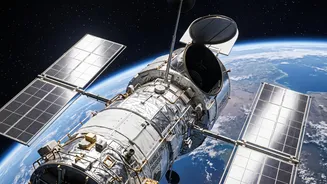
A more ambitious idea is a full servicing mission, reminiscent of the Space Shuttle's heroic visits. Beyond just an orbital boost, such a mission could involve astronauts or advanced robotics performing repairs and even upgrading Hubble's scientific instruments. This could potentially address aging components like its gyroscopes, which are essential for pointing the telescope accurately. NASA's recent request for information from commercial companies explicitly asks about concepts for both reboosting and servicing the spacecraft. This approach would not only extend Hubble's life but could also enhance its capabilities, ensuring it remains at the forefront of discovery.
The Commercial Space Race to the Rescue
With the Space Shuttle fleet retired, NASA is turning to the burgeoning commercial space industry for a solution. In late 2026, the agency issued a formal 'Request for Information' (RFI), inviting companies to submit their concepts and capabilities by the end of November. This RFI covers everything from a simple boost to a full service or even a controlled deorbit at the end of its life. While proposals have been floated before, including a privately funded mission concept from billionaire Jared Isaacman's Polaris Program, NASA has yet to commit funds or select a specific partner. The agency is currently in an information-gathering phase to assess the cost, risk, and feasibility of any potential mission, which would likely need to happen by 2032 to be effective.
What's at Stake?
Losing Hubble would be more than just the loss of a satellite. It has contributed to nearly 20,000 scientific papers and fundamentally reshaped our understanding of the universe. While newer observatories like the James Webb Space Telescope (JWST) are incredibly powerful, they are not direct replacements. JWST primarily observes in the infrared, whereas Hubble remains one of the most powerful instruments for observing in visible and ultraviolet light. Losing Hubble would leave a critical gap in our astronomical toolkit until a successor, like the proposed Habitable Worlds Observatory, is potentially launched in the 2040s. The decisions made in the next few years will determine whether this legendary observatory gets a second wind or becomes a spectacular, but final, shooting star.