


Catch the Finale of the Perseid Meteor Shower
While the spectacular peak of the Perseid meteor shower occurred in mid-August, the show isn’t over just yet. The shower remains active until around August 24, meaning patient observers can still catch some celestial fireworks. These meteors are pieces
of debris left behind by Comet Swift-Tuttle, and they burn up in our atmosphere, creating bright streaks of light. For your best chance to see these stragglers, find a location far from city lights. The hours after midnight and before dawn are typically the most active. The biggest challenge in August for most of India is cloud cover from the monsoon. However, regions that receive less rainfall, like Ladakh, Spiti Valley, and parts of the Thar Desert in Rajasthan, offer the clearest views. Even elsewhere, a clear night after a rainstorm can provide exceptionally transparent skies, perfect for spotting a few lingering Perseids.
The Dazzling Summer Triangle Overhead
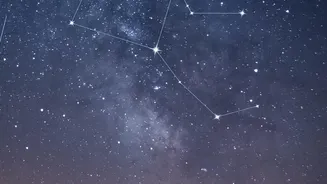
Dominating the night sky in August is the Summer Triangle, a large and easily identifiable asterism. It’s not a constellation itself, but rather a trio of brilliant stars from three different constellations. Look almost directly overhead to find Vega, the brightest of the three. To its lower left is Deneb, and to the southeast is Altair. Together, they form a massive triangle that serves as a perfect starting point for navigating the late summer sky. Vega is the brightest star in the constellation Lyra (the Harp), Deneb is the tail of Cygnus (the Swan), and Altair is the head of Aquila (the Eagle). These stars are so bright that they can be spotted even from areas with moderate light pollution, making them an accessible target for city-based skywatchers.
A Glimpse of Our Home Galaxy's Core
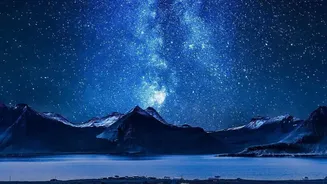
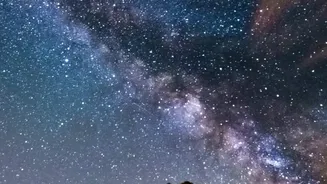
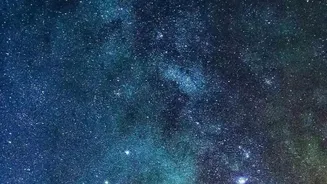
Late August is still a great time to witness one of the most breathtaking sights in the night sky: the core of our own Milky Way galaxy. From a truly dark location, this dense band of stars, gas, and dust stretches across the sky like a luminous cloud. To find it, look towards the southern horizon for the constellation Sagittarius, whose brightest stars form a shape resembling a teapot. The galactic centre is located just off the spout of this teapot. Seeing the Milky Way requires escaping urban light pollution, so a trip to a rural area or a designated dark-sky spot is essential. While the monsoon can be an obstacle, the periods of clear sky that follow a downpour can offer some of the most transparent conditions of the year, washing dust from the atmosphere and revealing the galaxy in all its glory.
Venus Shines Bright as the Evening Star
The planet Venus will be putting on a brilliant display throughout late August. After reaching its greatest eastern elongation in the middle of the month, the planet will hang like a radiant lantern in the western sky shortly after sunset. This is the best time to view Venus, as it will be at its highest point above the horizon in the evening. Its incredible brightness makes it impossible to miss; it will be the first 'star' to appear as twilight fades. You won’t need any special equipment to see it. Simply find a spot with an unobstructed view of the western horizon and look for the brightest object there as the sun goes down. Its steady, silvery light is a stark contrast to the twinkling of distant stars.
Watch the Moon Guide You to Saturn
The end of the month brings a special treat for planet lovers. From August 28 to 31, the Moon will pass close to the ringed planet, Saturn, offering a beautiful sight and an easy way to identify it. This celestial meetup serves as a prelude to Saturn's main event in October, when it will be at opposition—its closest and brightest for the year. During late August, Saturn will be rising in the east as evening progresses, appearing as a steady, yellowish point of light. The Moon will act as a convenient guidepost, drawing your eye right to it. On these nights, you can watch the Moon draw nearer to Saturn and then pass it. While you need a telescope to see its famous rings, spotting the planet itself with just your eyes is a rewarding experience.