



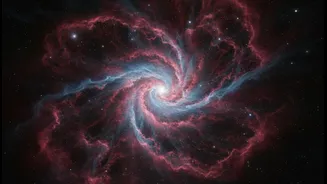


A Cosmic Upset
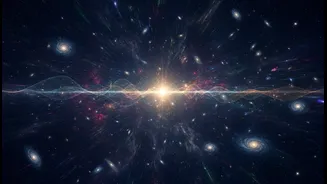
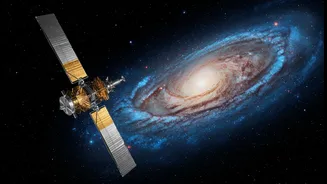
In a series of recent observations, the JWST has identified multiple supermassive black holes that are astonishingly large relative to their host galaxies in the very early universe. One such object was confirmed to exist just 570 million years after
the Big Bang. This is a cosmic chicken-and-egg problem; for decades, astronomers have debated whether galaxies form first and then grow black holes at their centres, or if the black holes act as seeds that galaxies grow around. These new findings suggest the latter might be more common than previously thought, with some black holes potentially forming before the stars in their own galaxy. This directly challenges long-held models of cosmic evolution.
How Webb Sees the Invisible
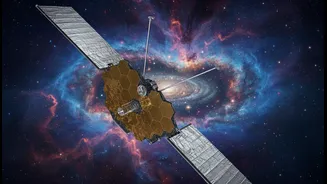
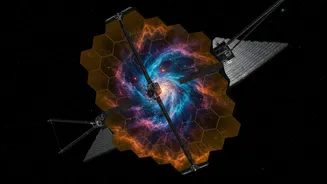
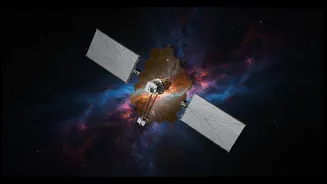
Observing these phenomena is a monumental technical achievement. Because the universe is expanding, light from these incredibly distant objects gets stretched as it travels across billions of light-years. Visible light emitted by a galaxy in the early universe is shifted into the infrared spectrum by the time it reaches us. This is where Webb's power lies. Its massive, gold-coated mirror and specialized infrared instruments, like the Near-Infrared Spectrograph (NIRSpec), can capture this faint, ancient light with unprecedented clarity. By analysing the spectrum of the light, astronomers can identify the chemical signatures and movements of gas, revealing the presence of an actively feeding, or 'accreting', black hole at a galaxy's core.
Rewriting the Galactic Playbook
The existence of these 'overmassive' black holes so early in cosmic history is a significant puzzle. Standard theories suggest that black holes form from the collapse of massive stars and grow over billions of years by merging with other black holes and consuming gas and stars. However, these newly discovered giants are too big, too soon. This suggests there might be another, faster way for them to form, such as the 'direct collapse' of a massive primordial gas cloud into a black hole, bypassing the star phase entirely. Finding evidence for this process has been a major goal for astronomers, and Webb's data provides some of the strongest clues yet.
The Turbulent Youth of Galaxies
Beyond the black hole mystery, Webb is painting a picture of the early universe as a far more chaotic and messy place than previously assumed. Recent surveys of hundreds of young galaxies show that most were not the neat, rotating spirals we see today. Instead, they were turbulent, clumpy, and irregular systems, frequently colliding and merging with each other. These constant interactions would have provided a steady stream of gas to fuel the rapid growth of the central supermassive black holes. It appears this violent, high-energy environment was the standard for galaxy formation, shaping the grand cosmic structures we observe in the modern universe.
India's Window to the Cosmos
While the JWST is an international collaboration, its discoveries galvanize the scientific community worldwide, including in India. Indian astronomers are at the forefront of cosmic research, utilizing facilities like the Giant Metrewave Radio Telescope (GMRT) near Pune, which studies the universe in different wavelengths of light. Discoveries from Webb provide crucial targets and context for research conducted from Indian soil. Global breakthroughs like these inspire a new generation of scientists and reinforce the importance of India's contributions to humanity's collective quest to understand our place in the universe. The data from Webb is also publicly available, allowing Indian researchers to participate directly in the analysis and interpretation of these groundbreaking findings.