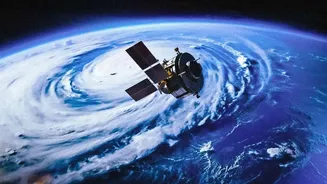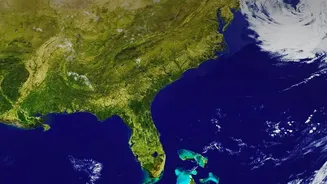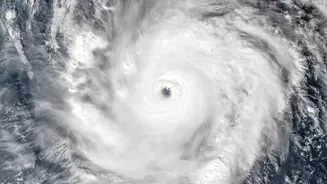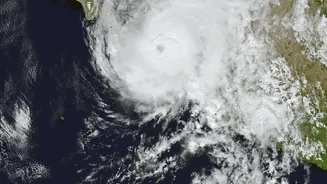





The US National Oceanic and Atmospheric Administration (NOAA) is tracking a strong El Niño event, with its influence expected to persist into early 2027. For India, this isn't just a distant weather report; it’s a critical alert for our economy.
What Exactly Is El Niño?
El Niño
is a naturally occurring climate pattern, part of the El Niño-Southern Oscillation (ENSO) cycle. In a normal year, trade winds blow warm surface water in the Pacific Ocean from east to west, from South America towards Asia. During an El Niño, these trade winds weaken. As a result, a massive expanse of warm water shifts eastward, accumulating in the central and eastern Pacific. This change in ocean temperature might seem remote, but it's powerful enough to disrupt atmospheric circulation across the globe, altering weather patterns from Australia to Africa and, crucially, influencing the Indian monsoon. These events typically happen every two to seven years and can last for nine to twelve months or more.
What Is the Latest Forecast?
The current El Niño, which began developing in mid-2026, is not just a regular event; it's being classified as a 'strong' to 'very strong' one. Forecasts from NOAA and the World Meteorological Organization show a near-certainty that El Niño conditions will continue through the Northern Hemisphere's winter and into early 2027, likely until at least March. Scientists have noted that this event is tracking closely with historic El Niños like the one in 1997-98. While it is expected to peak in late 2026, its atmospheric effects will continue to ripple across the globe well into the new year.
The All-Important Monsoon Connection
For India, El Niño's most significant impact is on the southwest monsoon, which delivers about 80% of the country's annual rainfall. A strong El Niño is historically associated with a weaker monsoon. The atmospheric changes it triggers can suppress the formation of rain-bearing clouds over the subcontinent, leading to deficient rainfall and a higher probability of drought. Historically, several of India's most severe droughts have coincided with El Niño years. However, the relationship is not a perfect one-to-one correlation. Other factors, like a positive Indian Ocean Dipole (IOD), can sometimes counteract El Niño's drying effect, as was seen in 1997 when the monsoon remained normal despite a strong El Niño.
Potential Impact on Agriculture
India's agricultural sector, which supports a majority of the population, is heavily dependent on monsoon rains. A weaker, delayed, or uneven monsoon can have severe consequences, particularly for the Kharif (summer) crops like rice, maize, and soybean, which are sown at the start of the season. Insufficient rainfall can delay sowing, stunt crop growth, and reduce yields. This puts immense pressure on rain-fed agricultural zones, which constitute a large portion of India's farmland. Furthermore, deficient rains affect the replenishment of reservoirs, which are vital for drinking water and for irrigating the subsequent Rabi (winter) crop season.
Economic Ripple Effects to Watch
The impact of a poor monsoon extends far beyond the farm. A downturn in agricultural production can squeeze rural incomes, dampening demand for goods and services across the economy. More directly for urban consumers, a shortfall in the supply of essential food items like cereals, pulses, and vegetables can lead to a spike in food inflation, putting pressure on household budgets. It also affects related sectors, from hydroelectric power generation, which relies on healthy reservoir levels, to industries that use agricultural raw materials. Therefore, a strong El Niño is not just a weather story but a significant economic headwind that policymakers monitor closely.
A Glimmer of Hope for the 2027 Monsoon?
While the current strong El Niño is expected to dominate through early 2027, some Indian scientific bodies are already looking at what comes next. A forecast from the Indian National Centre for Ocean Information Services (INCOIS) suggests a possible silver lining. Their models indicate that after the current El Niño event weakens and transitions to neutral conditions around April-June 2027, there is a possibility of La Niña conditions developing. La Niña, the cooler counterpart to El Niño, is typically associated with a stronger-than-average monsoon for India. While this is still a developing forecast, it suggests that relief could potentially be on the horizon for the main 2027 monsoon season, even as the country navigates the immediate effects of the ongoing El Niño.