



More Than Just Abs
When we talk about a 'functional core', we're referring to the entire group of muscles in your midsection that work together to stabilize your body. This includes your abs, obliques, lower back muscles, and even your glutes and pelvic floor. Think of your core as
the central link connecting your upper and lower body. A strong, functional core doesn't just look good; it improves your posture, enhances balance, reduces the risk of back pain, and makes everyday activities like lifting groceries or playing with your kids feel easier and safer.
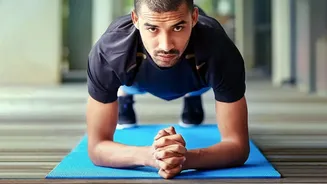
1. The Forearm Plank
The plank is a classic for a reason: it's a test of pure stability. It trains your core muscles to resist gravity and keep your spine in a safe, neutral position. To perform it, lie face down and prop your body up on your forearms and toes. Ensure your elbows are directly under your shoulders. Your body should form a straight, rigid line from your head to your heels—no sagging hips or raised bottoms. Squeeze your glutes and draw your belly button toward your spine to engage your deep abdominal muscles. Aim to hold this position with perfect form for 30 to 60 seconds.
2. The Bird-Dog
This exercise is a champion of stability and coordination. Start on all fours, with your hands directly under your shoulders and your knees under your hips. Keeping your back flat and your core tight, slowly extend your right arm straight forward and your left leg straight back. The goal is to create a straight line from your fingertips to your heel while keeping your hips and shoulders perfectly square to the floor. Hold for a moment, then return to the starting position with control. Repeat on the other side, alternating for 10-12 reps per side. This move teaches your core to resist rotational forces, which is crucial for protecting your spine.
3. The Glute Bridge
Your glutes are a vital part of your core's posterior chain. A strong backside supports a healthy lower back. Lie on your back with your knees bent, feet flat on the floor about hip-width apart, and your arms by your sides. Squeeze your glutes and press your hips toward the ceiling until your body forms a straight line from your shoulders to your knees. Be careful not to over-arch your lower back. Hold the squeeze at the top for a second before slowly lowering your hips back down. This simple move powerfully activates your glutes and hamstrings, key partners to your deep core muscles.
4. The Dead Bug
The Dead Bug is deceptively challenging and fantastic for training the deep transverse abdominis, the muscle that acts like a natural corset for your torso. Lie on your back with your arms extended toward the ceiling and your knees bent at a 90-degree angle over your hips (a 'tabletop' position). Keeping your lower back pressed gently into the floor, slowly lower your right arm and left leg toward the ground simultaneously. Go only as low as you can without your back arching. Return to the start with control and repeat on the opposite side. The key is to move slowly and deliberately, keeping your core engaged the entire time.
5. The Hollow Body Hold
For a more advanced challenge, the hollow body hold is an incredibly effective way to build total core stiffness and strength. Lie on your back and extend your arms and legs. Press your lower back firmly into the floor as you lift your shoulders and legs a few inches off the ground, creating a shallow 'banana' shape with your body. Your arms should be by your ears and your legs straight. The goal is to hold this tense position, keeping your core completely braced. Start with short holds of 15-20 seconds and build up from there. It's a humbling exercise that delivers serious functional power.