


Cosmic Clouds and Stellar Nurseries
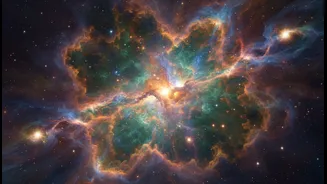
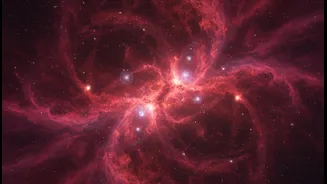
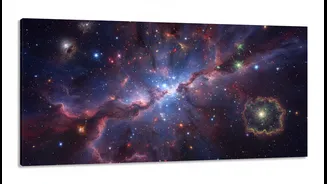
Before a star can shine, it must gather its ingredients from the vastness of space. These ingredients exist within enormous, cold clouds of gas and dust known as nebulae. For a long time, these stellar nurseries were mostly mysterious, their dense dust obscuring
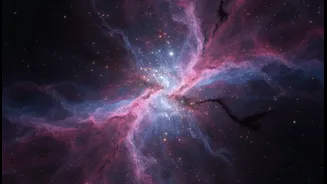
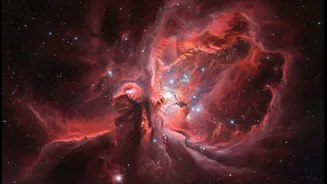
what was happening inside. But Hubble, with its powerful optics, changed everything. It gave us iconic images of places like the Orion and Carina Nebulae, revealing them not as quiet clouds, but as turbulent, active regions where the cycle of cosmic creation is in full swing. These regions contain the raw materials—primarily hydrogen and helium—that will eventually form entire clusters of new stars.
Gravity's Gentle, Unstoppable Pull
Within these giant molecular clouds, the process begins when gravity starts to win. A slightly denser pocket of gas and dust begins to attract more material, creating a snowball effect. As the clump grows, its gravitational pull increases, drawing in even more gas and dust from its surroundings. This process of collapse is the first crucial step in forming a star. Hubble has been instrumental in observing these dense cores, showing us the very beginnings of stellar systems. In some cases, external triggers like the shockwave from a nearby supernova can kickstart this collapse, compressing the gas and initiating the formation of dozens or even hundreds of stars at once.
The Fiery Birth of a Protostar
As the core of the collapsing cloud becomes denser, the pressure and temperature at its center skyrocket. This hot, dense, and still-growing object is called a protostar. Protostars are not yet true stars because they don't generate energy through nuclear fusion. Instead, they glow from the heat generated by their ongoing gravitational contraction. One of Hubble's most important contributions has been its ability to see these infant stars. Because protostars are still wrapped in thick cocoons of dust, they are often invisible in normal, visible light. However, Hubble's infrared instruments can pierce through the dust, revealing the glowing protostars hidden within. It has even captured images of powerful jets of material being blasted out from the protostar's poles.
From Protostar to Star: The Ignition
A protostar continues to gather mass from a surrounding disk of gas and dust for millions of years. As it contracts, the temperature and pressure in its core continue to climb. Eventually, it reaches a critical point—around 10 million degrees Celsius—where nuclear fusion can begin. At this moment, hydrogen atoms start fusing together to form helium, releasing an immense amount of energy in the process. This outward push of energy finally halts the gravitational collapse. A star is born. This newfound stability marks its entry onto what astronomers call the "main sequence," the long, stable phase where stars like our own Sun spend most of their lives. Hubble has observed thousands of these "pre-main-sequence" stars, giving scientists crucial data on how long this final growth stage can last.
Hubble's Enduring Legacy
Perhaps no image better represents Hubble's contribution to this field than the famous "Pillars of Creation" in the Eagle Nebula. First imaged in 1995, these towering columns of gas and dust show star formation in action. The pillars themselves are being sculpted and eroded by the intense radiation from a cluster of young, massive stars located just out of frame. Within the pillars, Hubble revealed the presence of newborn stars, providing direct, visual proof of theories that had been debated for decades. By revisiting the pillars and other stellar nurseries over the years, Hubble has provided a time-lapse view of cosmic evolution, turning abstract concepts into some of the most awe-inspiring images in the history of science.