
A Faint Discovery in the Outer Darkness
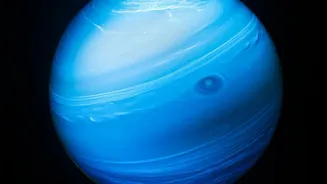
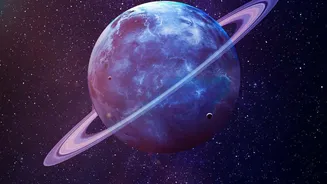
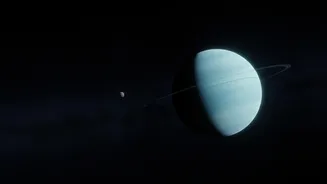
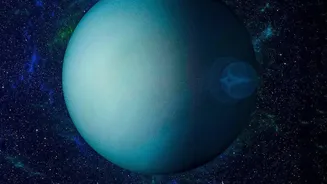
The newest member of Uranus's celestial family, provisionally named S/2023 U1, is almost unimaginably small and distant. First spotted in November 2023 by astronomer Scott S. Sheppard using the powerful Magellan telescopes in Chile, it is a mere 8 kilometres
in diameter, making it probably the smallest of Uranus's 28 known moons. Its discovery wasn't easy; it required special image processing techniques to pick its faint light out from the background noise of distant stars. S/2023 U1 follows a long, 680-day orbit far from its parent planet, a path so wide and looping that it hints at a dramatic past. In keeping with tradition for Uranian satellites, it will eventually be named after a character from a Shakespeare play.
The Irregular Moons and Their Story
Not all moons are created equal. Many, like Earth's own moon, are thought to have formed from a disc of debris orbiting their host planet. But S/2023 U1 belongs to a different class: the irregular moons. These objects have distant, eccentric, and inclined orbits that suggest they weren't born in place. Instead, they are believed to be captured objects—ancient asteroids or comets that wandered too close to the young planet's immense gravity and were pulled into orbit. This new moon's orbit is similar to two other Uranian moons, Caliban and Stephano, suggesting they may all be fragments of a single, larger parent body that was captured and then shattered by a collision millions or billions of years ago.
Solving the Ice Giant Puzzle
This is where the story of planetary formation gets interesting. The giant planets of our outer solar system fall into two categories: the gas giants (Jupiter and Saturn) and the ice giants (Uranus and Neptune). While we have relatively good models for how the gas giants and their extensive moon systems formed, the ice giants remain more mysterious. Finding and studying their outer moons provides crucial data points. The configurations of these outer moon systems are surprisingly similar across all giant planets, regardless of their size or how they formed. Discovering S/2023 U1 helps complete the inventory of Uranus's moons down to a certain size, allowing for better comparisons with Neptune, Saturn, and Jupiter.
A Window into a Chaotic Past
Each captured moon like S/2023 U1 is a fossil from the early solar system. Their existence and orbits provide tangible evidence of the chaotic environment in which the planets grew. The solar system's youth was a turbulent time, filled with migrating planets and a vast population of smaller objects constantly colliding and interacting. By studying the orbits of these captured fragments, scientists can reverse-engineer their history. They can refine computer models that simulate planetary formation, testing theories about how planets migrated, what kinds of objects were common in the early solar system, and how often capture events occurred. Finding these groupings of moons supports the idea that the early solar system was a dynamic and violent place, where collisions shaped the planetary systems we see today.