


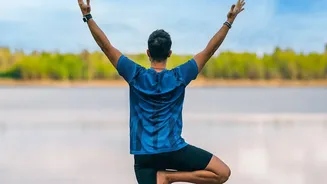


Ever find yourself wobbling in Tree Pose? The secret to finding stability isn't just in your legs—it's in your lungs. Discover how conscious breathing can transform your balance and explore variations to deepen your practice.
The Breath-Balance Connection
In yoga, the breath, or 'prana',
is the vital life force that connects mind and body. When you feel unsteady in a balancing posture, the natural reaction is often to tense up and hold your breath. This triggers the body's 'fight or flight' response, activating the sympathetic nervous system and making balance even more difficult. By intentionally shifting to slow, deep, and steady breathing, you engage the parasympathetic nervous system, often called the 'rest and digest' system. This simple act sends a signal of safety to your brain, which helps calm mental chatter, release physical tension, and allow your body to find its natural equilibrium. A focused breath quiets the mind's distractions, allowing you to stay present and centered, turning a challenging pose into a mindful meditation.
Mastering Classic Tree Pose (Vrikshasana)
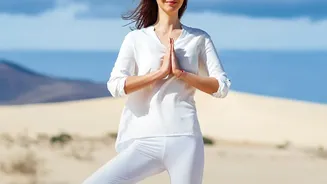
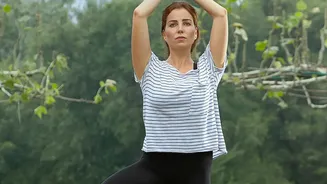
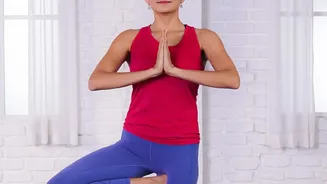
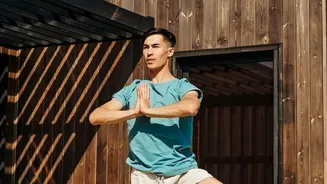
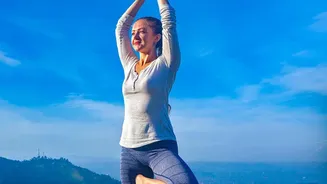
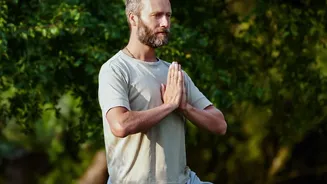
Vrikshasana, or Tree Pose, replicates the steady, grounded stance of a tree. To begin, stand tall in Mountain Pose (Tadasana) with your feet together and arms at your sides. Shift your weight onto your left foot, spreading the toes to create a stable foundation. Engage the muscles of your standing leg to keep it strong and straight, but avoid locking the knee. Bend your right knee and use your hand to place the sole of your right foot high on your left inner thigh. Crucially, press the foot firmly into the thigh and the thigh back into the foot to create a stable connection. Bring your hands together in a prayer position at your heart, or for a greater challenge, raise them overhead like branches. To maintain balance, fix your gaze (drishti) on a non-moving point in front of you. Hold for 5 to 10 deep breaths before gently releasing and repeating on the other side.
Variations for Building Your Roots
If placing your foot on the inner thigh feels inaccessible, there are several wonderful variations to help you build confidence. The most important rule is to never place your foot directly on the side of your knee, as this can strain the joint. A great starting point is to place the toes of your bent leg on the floor, resting your heel against the inner ankle of your standing leg for support. As you feel more stable, you can progress to placing the sole of your foot on your inner calf, below the knee. For additional support, don't hesitate to practice near a wall, placing a hand on it to help you find your balance before bringing your hands to your heart. You can also practice while seated in a chair, which helps you focus on hip-opening and upper body alignment without the challenge of balancing.
Exploring Deeper Expressions of Tree
Once you feel stable in the classic pose, you can explore variations that challenge your balance and focus further. Try changing your arm position: extend them out to the sides like wide branches, or interlace your hands in Eagle Pose arms for an added shoulder stretch. A significant challenge is to briefly close your eyes; this removes your visual anchor and forces you to rely on proprioception—your body's internal sense of its position. For a deeper hip opener, you can work toward Half-Lotus Tree Pose (Ardha Padmasana in Vrksasana), where the top of the lifted foot rests on the opposite hip crease. More dynamic variations include adding a side bend away from the lifted leg or even transitioning into the pose from a side plank for a powerful core and upper body workout.
Common Mistakes and How to Adjust
One of the most frequent misalignments is placing the foot directly on the knee joint, which creates unsafe pressure. Always position the foot either above or below the knee. Another common tendency is to let the hip of the bent leg side hike up, creating imbalance in the pelvis. To correct this, consciously drop the hip so your pelvic points are level. It's also common to lean the torso to one side to counterbalance. Instead, engage your core muscles to keep your spine long and centered over your standing leg. Finally, ensure your standing leg is active by lifting the kneecap and engaging the thigh muscles, which provides the solid 'trunk' your tree needs to stand tall.