


The Cosmic Stakeout
Imagine trying to understand a creature you can never see directly. That's the challenge for astrophysicists studying supermassive black holes. These objects, millions or billions of times the mass of our sun, have a gravitational pull so strong that
not even light can escape. The only way to 'see' them is by observing their immense influence on their surroundings. This is not a quick process. Astronomers must conduct a cosmic stakeout, patiently monitoring the same patch of sky for years, even decades. Only by collecting data over these long periods can they detect the subtle, slow changes that offer clues to the nature of the beast hiding at the center of a galaxy.
Watching Stars on a Dangerous Dance
One of the most powerful methods involves watching stars that orbit a supermassive black hole. At the heart of our own Milky Way galaxy lies Sagittarius A, a black hole with a mass of about four million suns. For decades, astronomers have tracked the orbits of stars caught in its gravitational grip. By precisely measuring the paths of these stars over many years, they can essentially 'weigh' the black hole with incredible accuracy. One star, S2, completes a full orbit in about 15 years. Tracking its entire journey allowed scientists to confirm the existence and mass of Sagittarius A beyond any reasonable doubt, providing some of the best evidence that these cosmic giants truly exist. More recent observations are hunting for even subtler effects, like how the black hole's spin might twist spacetime and alter stellar orbits.
The Flicker of a Quasar
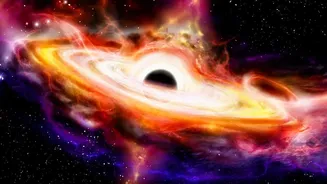
Another key clue comes from the dramatic flickering of quasars. Quasars are the intensely bright, active hearts of distant galaxies, powered by supermassive black holes furiously consuming gas and dust. This material forms a swirling, superheated structure called an accretion disk before it's devoured. These disks are not steady; they flare and dim over time. Monitoring this variability over years helps scientists understand the physics of the accretion disk itself. The speed and nature of the flickering can be linked to the black hole's mass and how efficiently it's feeding. Some changes, like a sudden, sustained brightening, can signal a dramatic event, such as the black hole tearing a star apart in what's known as a tidal disruption event.
From Burps to Jets
Long-term observation also helps connect a black hole's 'meal' to the 'burp' that follows. After a black hole accretes a large amount of matter, it can launch powerful jets of plasma that travel near the speed of light. These jets can extend for thousands of light-years and have a major impact on their host galaxy. But there's often a delay between the initial feeding frenzy, which is visible in X-rays, and the launch of the radio-wave-emitting jet. Recent studies using over a decade of data from observatories like NASA's Swift satellite have been able to measure this delay, finding it can be hundreds of days. This timing provides crucial information about how these powerful jets are formed and launched from the edge of the black hole.
Building a Complete Picture
Each of these long-term observations provides a different piece of the puzzle. Stellar orbits reveal the black hole's mass and gravity. Quasar variability gives insight into its feeding habits and the chaotic environment of the accretion disk. And tracking jets reveals how a black hole outputs energy back into its galaxy. Combined, these decade-long cosmic changes allow physicists to move beyond static snapshots. They can create dynamic models of how supermassive black holes grow, interact with their galaxies, and shape the evolution of the universe over billions of years. This long, patient gaze is what turns a mysterious, invisible object into something we can begin to understand.