


Our Star's Final Act
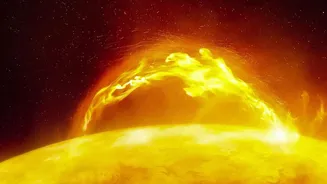
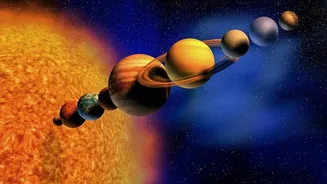
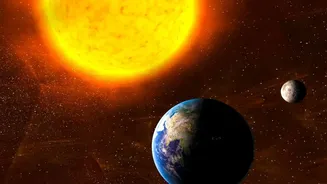
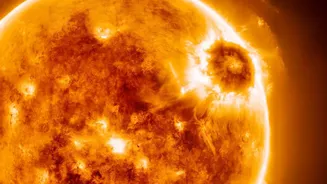
In about five billion years, our Sun will run out of the hydrogen fuel in its core that has sustained it for ages. This will trigger a dramatic transformation. The Sun will swell into a red giant, expanding its outer layers so enormously that they will engulf
and destroy the inner planets: Mercury, Venus, and possibly even Earth. After this fiery phase, which could last a billion years, the Sun will shed its outer layers and collapse into a white dwarf — a super-dense, Earth-sized remnant of its former self that will slowly cool over trillions of years.
A New, More Chaotic Timetable
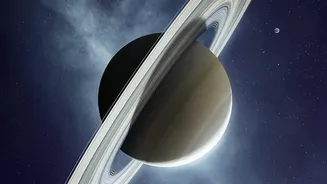
For years, astronomers believed that while the inner planets were doomed, the gas and ice giants—Jupiter, Saturn, Uranus, and Neptune—would survive this process. Their orbits would expand as the Sun lost mass, but they were expected to remain in a stable configuration for an almost unimaginable length of time, potentially a quintillion (a billion billion) years. However, a recent study from researchers at the California Institute of Technology paints a much more violent and compressed picture. Their new simulations suggest the outer solar system's stability may last only about one billion years after the Sun becomes a white dwarf, cutting its expected lifespan by a factor of a billion.
The Trouble with Mass Loss
The key difference in the new research lies in how the Sun loses mass. Previous models often assumed a smooth, consistent shedding of its outer layers. The new study, published in The Astrophysical Journal Letters, argues that this process will be much more uneven and violent. Instead of a gentle release, the Sun will likely eject its mass in random, powerful bursts, creating 'stochastic kicks' that will nudge the star itself. These kicks, though small, introduce a new level of gravitational disturbance into the system, shaking the delicate orbital balance of the remaining planets.
A Solar System in Disarray
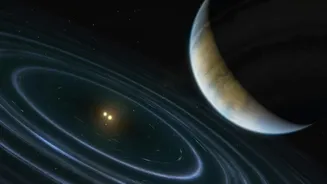
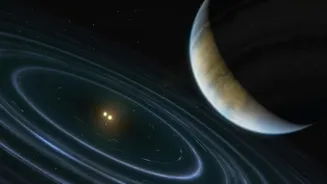
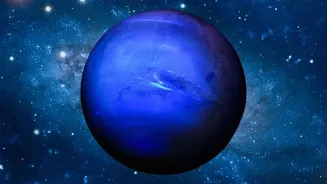
As the Sun's gravitational grip weakens from its mass loss, the giant planets will drift into wider orbits. This expansion makes the system more susceptible to disruption. The gravitational kicks from the dying Sun can amplify these instabilities, pushing the giant planets into chaotic interactions. According to the hundreds of simulations run by the research team, this gravitational mess can have dramatic consequences. In some scenarios, Uranus and Neptune are ejected from the solar system entirely, becoming rogue planets wandering through interstellar space. In others, the giants' orbits become highly erratic, and some simulations even showed the system becoming unstable while the Sun was still in its red giant phase.