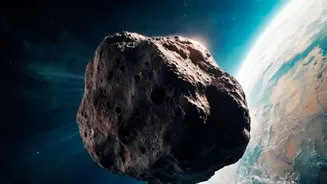




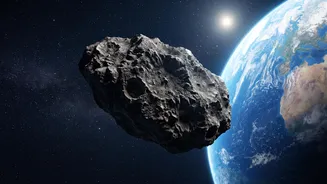

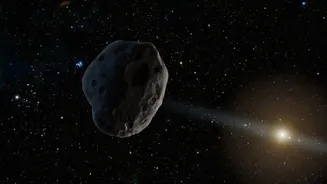
For months, Earth has had a secret companion. A small asteroid, dubbed 2026 QQ8, was captured by our planet's gravity in April and has been looping around us ever since. But what is this 'tiny visitor', and is it here to stay?
Meet Our Temporary Neighbour
First spotted in August 2026
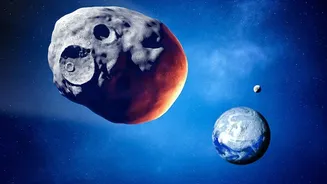
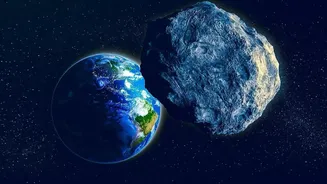
by Hungarian astronomer Krisztián Sárneczky, the object initially puzzled scientists. At just one to two metres in diameter—roughly the size of a small car—it was so small and dim that it took several weeks of observation to confirm it was a natural asteroid and not a piece of leftover space junk, like a defunct satellite part. After follow-up studies using powerful telescopes, the International Astronomical Union's Minor Planet Center officially named the object 2026 QQ8 in late October, confirming its status as a temporarily captured object, or 'mini-moon'.
Not a Second Moon, But a 'Quasi-Satellite'
While the term 'mini-moon' is evocative, 2026 QQ8 isn't a moon in the same way our familiar Moon is. True satellites are gravitationally bound to a planet and orbit it directly. This visitor is what astronomers call a quasi-satellite. These objects are in a 1:1 orbital resonance with Earth, meaning they take almost the exact same amount of time to orbit the Sun as our planet does. However, they aren't gravitationally locked to Earth. Instead, they follow their own complex, looping path around the sun that just happens to keep them in our cosmic neighbourhood for a while.
A Complex Cosmic Dance
Imagine you and a friend are walking on a large circular track at almost the same speed. You'll stay close to each other for a long time, sometimes one pulling ahead, sometimes falling behind, but always in the same general area. That's a simplified way to picture the relationship between Earth and 2026 QQ8. From our perspective on Earth, the asteroid appears to trace a strange, oblong loop around us. This happens because its orbit has a different shape (eccentricity) than Earth's. This temporary capture occurred in April 2026 when the asteroid passed through Earth's 'Hill sphere'—the region of space where our planet's gravity is dominant enough to snag a passing object.
No Cause for Alarm
The most important thing to know about our temporary companion is that it poses zero threat. Even at its closest point, 2026 QQ8 was about 1.5 times farther away from us than the Moon. Its small size is another key factor in its harmlessness. According to astronomers, even if its trajectory were to intersect with Earth, an object this tiny would completely burn up and disintegrate in our atmosphere, at most creating a bright fireball or meteor in the sky. Its visit is purely a scientific curiosity, offering a valuable chance for astronomers to study these small, transient objects that are surprisingly common but difficult to detect.
A Fleeting Friendship
Our cosmic friendship with 2026 QQ8 is destined to be a short one. The same gravitational forces that brought it here will soon guide it away. Most predictions suggest the asteroid will break free from Earth's gravitational influence in early December 2026, or by January 2027 at the latest, continuing on its own independent orbit around the Sun. This isn't the first time Earth has had a temporary roommate. Asteroids like 2006 RH120 and 2020 CD3 have had similar short-term stays. These events remind us that the solar system is a dynamic and ever-changing place, full of visitors just passing through.