



The Enduring Mystery of the North Pole Hexagon
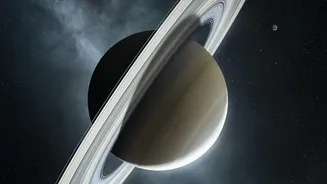
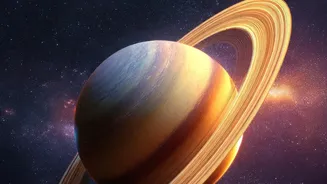
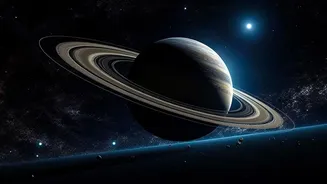
Since NASA's Voyager spacecraft first flew by Saturn in the early 1980s, scientists have been captivated by a bizarre feature at its north pole: a near-perfect hexagon swirling in the clouds. This is no small pattern; it's a weather system nearly 25,000
kilometres across, wide enough to fit almost four Earths inside. Unlike a hurricane on Earth that lasts for days or weeks, Saturn's hexagon is a remarkably persistent jet stream that has remained stable for more than 40 years. This long-lived geometric storm has been a source of fascination and intense study, a seemingly permanent fixture on a dynamic, gaseous world. For years, it was thought to be a one-of-a-kind spectacle, as the planet's south pole appeared to only have a more conventional, circular vortex.
A New Shape Appears in the South
In a dramatic twist, recent observations from the Hubble Space Telescope have revealed that the hexagon is no longer alone. As of early September 2026, scientists announced the discovery of a 10-sided polygon—a decagon—that has recently formed around Saturn's south pole. A team of researchers analysing Hubble data noticed the feature beginning to emerge in images from 2023, becoming progressively more distinct through 2024 and 2025. The discovery, published in the journal Science Advances, was a collaborative effort, even involving amateur astronomers who had spotted a faint, wavy band in their own ground-based images. After decades of searching and finding nothing similar to the northern hexagon, a brand new, and completely different, polygon has suddenly appeared.
A Tale of Two Poles
The existence of a second polygon is stunning, but it's the differences between the two that are truly exciting for scientists. While the northern hexagon is a famously stable and long-lived feature, the southern decagon is a newborn. We are witnessing its formation in near real-time. This gives researchers a rare opportunity to watch a giant atmospheric pattern develop and test their theories about how such phenomena are born. Furthermore, the two shapes are different. One has six sides, the other has ten. One has been around for decades, the other for just a few years. This contrast shatters the idea that Saturn's deep atmosphere is timeless and unchanging, revealing it to be a place of active, large-scale evolution.
The Physics of Planetary Polygons
So why do these shapes form at all? They are not solid structures, but rather atmospheric waves embedded within powerful jet streams. The leading theory suggests they are a type of standing wave, known as a Rossby wave, that forms from instabilities in winds flowing at different speeds. Scientists have recreated similar polygonal shapes in laboratories by spinning a circular tank of liquid at varying speeds. The number of sides that appear can change depending on the fluid's properties and the rotational speed. On a gas giant like Saturn, these shapes are powerful diagnostics. Their existence and geometry are thought to be influenced by factors deep within the planet's atmosphere, far below the visible clouds. The fact that Saturn produces these features, while the poles of its sibling giant Jupiter host clusters of smaller circular cyclones, is a key mystery in planetary science.
A Live Laboratory for Atmospheric Science
The discovery of the decagon matters because it turns Saturn's atmosphere into a live laboratory. Instead of just studying one static, ancient hexagon, scientists can now compare two different polygons and watch one evolve. This allows them to refine the complex computer models used to simulate the atmospheres of giant planets. Understanding the forces that create and sustain these jet stream patterns on Saturn provides crucial insights into the fundamental physics of rapidly rotating, fluid-rich planets across the solar system and beyond. Some of these same physical principles apply to the jet streams that shape weather on Earth, so studying these extreme examples helps us better understand our own planet's atmospheric behaviour. The decagon is more than just a curiosity; it's a key to unlocking the secrets of how weather works on a planetary scale.