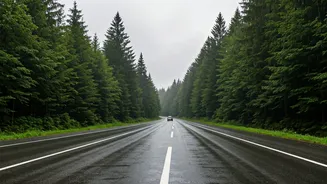










The Twin Threats: Slippery Roads and Lost Signal
Driving during India's rainy season presents a unique set of challenges. Heavy downpours drastically reduce visibility, while the mix of rainwater and road grime creates dangerously slick surfaces. This loss of traction increases the risk of hydroplaning,
where your tyres lose contact with the road and skim across a layer of water, making steering and braking nearly impossible. Compounding this is the modern reliance on navigation apps, which often falter in severe weather due to weak or lost mobile connectivity. Finding yourself on an unfamiliar, flooded street without directions is a scenario that is both stressful and avoidable.
Your Digital Lifeline: Why Offline Maps Are Essential
This is where offline maps become a crucial safety tool. Well before you start your journey, you can download a detailed map of your intended area or route directly to your phone. Popular applications like Google Maps allow you to save large areas, ensuring you have full turn-by-turn navigation even with zero internet connection. This means you can reroute around unexpected waterlogging or traffic jams without worrying about a frozen screen. While you won't get real-time traffic updates, having the basic road layout and your location locked in via GPS is an invaluable backup. It's a simple act of preparation that transforms your phone from a potential liability into a reliable co-pilot.
How to Download a Map for Offline Use
Downloading a map on most navigation apps is straightforward. For Google Maps, simply open the app, tap your profile picture, and select 'Offline maps'. From there, choose 'Select Your Own Map' and adjust the rectangle to cover your city, district, or specific travel route before tapping 'Download'. The app will show you how much storage space is required. For a typical city, this is usually a few hundred megabytes. It's a small price to pay for the peace of mind that comes with knowing your navigation will work, no matter how hard the rain falls.
Beyond the Map: Core Rules of Monsoon Driving
Technology is helpful, but it's no substitute for cautious driving. The single most important adjustment is to reduce your speed significantly. Stopping distances on wet roads can be at least double those on dry surfaces. Increase the gap between you and the vehicle in front to at least three or four seconds. Avoid sudden acceleration, braking, or sharp turns, as these manoeuvres can easily lead to a skid. Ensure your headlights are on—even during the day—to improve your visibility to other drivers, but avoid using hazard lights while moving, as this can create confusion about your intentions.
Navigating Waterlogged Roads and Potholes
One of the biggest monsoon hazards in India is driving through standing water, which can hide deep potholes or debris. It's often impossible to judge the depth of a flooded area. If you can, avoid driving through it entirely. If it's unavoidable, proceed at a slow, steady speed in a low gear to create a bow wave and prevent water from flooding the engine's air intake. Remember, it takes a surprisingly small amount of water to stall an engine or even cause a vehicle to float. After passing through water, gently tap your brakes a few times to dry them and ensure they are working effectively.
Vehicle Prep: Your First Line of Defence
A prepared car is a safer car. Before the monsoon hits its peak, check your vehicle's essentials. Your tyres are critical; ensure they have adequate tread depth (at least 2-3mm) to effectively channel water and maintain grip. Worn tyres are a primary cause of hydroplaning. Test your windscreen wipers and replace the blades if they leave streaks or squeak. A clear view is non-negotiable. Finally, confirm all your lights—headlights, taillights, and indicators—are clean and functioning perfectly. These simple checks can prevent a breakdown or an accident when conditions are at their worst.