



The Great Cosmic Deception
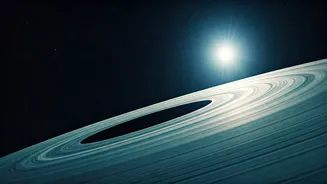
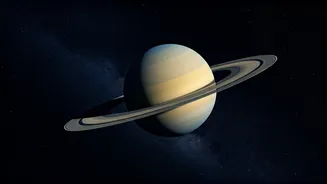
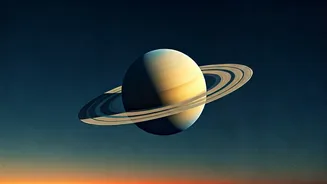
From our vantage point on Earth, even through a powerful telescope, Saturn’s rings look like a continuous, solid disc, almost like the grooves on a vinyl record. They appear flat, coherent, and immaculately structured. This is why for centuries, early
astronomers were baffled. Galileo Galilei, the first to observe them in 1610, thought he was seeing two large moons on either side of the planet. It wasn't until Christiaan Huygens used a better telescope in 1655 that he proposed it was a ring surrounding the planet. The illusion of solidity is created by distance and density. The particles are packed together in a remarkably thin plane—in some places, only about 10 metres thick—but they stretch across a vast distance of up to 282,000 kilometres. From billions of kilometres away, our eyes and even our telescopes blend these countless individual points of light into what appears to be a single, unbroken surface.
A Blizzard of Ice and Rock
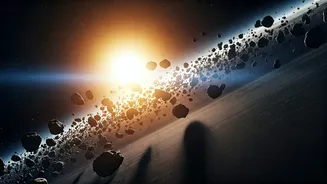
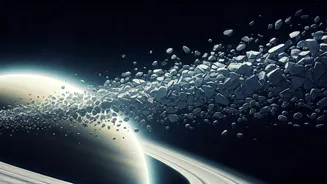
So, if not a solid structure, what are the rings made of? The answer is far more dynamic and fascinating: they are an immense collection of individual particles, orbiting Saturn together. These particles are overwhelmingly composed of water ice—about 99.9% pure. The remaining fraction is a mix of rocky material and dust, likely contaminants from micrometeoroid impacts. The size of these icy chunks varies dramatically. The vast majority are tiny, like grains of sand or specks of dust. However, mixed within are larger pieces, ranging from the size of a pebble to a car, and even a few massive 'moonlets' that can be as large as a mountain or a small house. Imagine a colossal, orbiting blizzard frozen in the vacuum of space. Each of these billions of particles is its own tiny satellite, following its own orbit around Saturn, creating the complex structures of rings and gaps we observe.
How We Cracked the Case
Our definitive understanding of the rings is a modern achievement, thanks largely to robotic explorers. While the Voyager 1 and 2 flybys in the early 1980s provided spectacular close-ups, it was the Cassini-Huygens mission that truly revolutionised our knowledge. Orbiting Saturn from 2004 to 2017, the Cassini spacecraft spent 13 years studying the planet and its rings in unprecedented detail. It flew directly through the gaps in the rings, sampled the particles, and measured their composition, size, and distribution. During its 'Grand Finale' in 2017, Cassini made a series of daring dives between Saturn and its innermost ring, providing data that confirmed the rings were almost pure ice and were 'raining' down onto the planet's atmosphere. These missions transformed the rings from a beautiful mystery into a well-understood, though no less wondrous, physical system.
Are the Rings Forever?
One of the most surprising discoveries from the Cassini mission is that Saturn's rings are not a permanent feature. They are, in cosmic terms, a fleeting spectacle. Data shows that the ring material is being constantly pulled inward by Saturn’s gravity and electromagnetic field, falling onto the planet as an icy 'ring rain.' Scientists estimate that the rings are losing mass at a significant rate, enough to drain an Olympic-sized swimming pool every half hour. Based on this rate of decay, the rings are projected to disappear completely within the next 100 to 300 million years. This might sound like a long time, but in the 4.5-billion-year lifespan of the solar system, it’s a mere blink of an eye. This finding suggests the rings are also relatively young, likely forming no more than 100 million years ago, possibly from a shattered icy moon that strayed too close to Saturn.