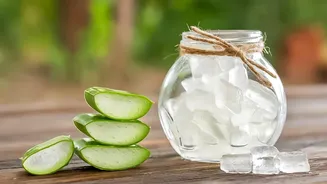







DIY beauty hacks often go viral with bold promises. One of the latest is 'retinol ice cubes' made from cucumber and aloe. But can this simple, natural mixture really replicate the effects of one of skincare's most powerful ingredients? Let's find out.
The Viral Sensation Explained
Scroll through social media, and you will likely encounter videos of people rubbing green-hued ice cubes over their faces, promising glowing, smooth, and revitalized skin. This trending DIY hack involves blending fresh cucumber and aloe vera gel, freezing the mixture in a tray, and using the resulting cubes as a facial treatment. The appeal is obvious: it is inexpensive, easy to make, and uses ingredients celebrated for their natural properties. The most eye-catching claim, however, is that this concoction is a form of 'DIY retinol', suggesting it can offer the same powerful anti-aging and skin-renewing benefits as professionally formulated products. For many, this sounds like the perfect natural alternative to a sometimes-intimidating ingredient.
What's Really in Cucumber and Aloe?
To understand the trend, we have to look at the ingredients. Cucumber is about 95% water, making it exceptionally hydrating. It also contains antioxidants like Vitamin C, which can help brighten the skin, and has a well-earned reputation for cooling and soothing, which helps reduce puffiness. Aloe vera is another skincare hero, long used for its healing and moisturizing abilities. It contains over 75 active compounds, including vitamins and enzymes that help soothe irritation, reduce redness, and promote skin repair, especially after sun exposure. When combined, these two ingredients create a mixture that is undeniably hydrating, calming, and refreshing for the skin.
The 'Retinol' Misconception
This is where the DIY claim gets complicated. Retinol is a specific, pre-formed type of Vitamin A, highly valued in dermatology for its proven ability to accelerate skin cell turnover and boost collagen production. Neither cucumber nor aloe vera contains retinol itself. What they do contain are carotenoids, like beta-carotene, which are precursors to Vitamin A. This means that, when consumed, the body can convert them into Vitamin A as needed. However, applying these precursors topically is not the same as applying pure, formulated retinol. The conversion process on the skin is inefficient, and the resulting effect is far gentler and less potent than a true retinoid product. While plant-based Vitamin A precursors are beneficial antioxidants, they cannot deliver the dramatic anti-aging results associated with retinol.
The Power of Cold: Skin Icing
The other half of this trend is the 'ice cube' format. Applying cold to the face, a practice known as skin icing or cryotherapy, has its own set of temporary benefits. The cold temperature causes blood vessels to constrict, which can quickly reduce puffiness and inflammation, especially around the eyes. As the skin warms up, blood flow increases, which can create a temporary healthy-looking glow. This is why many people find the practice so satisfying for a morning pick-me-up or before an event. However, dermatologists caution against applying ice directly to the skin, as it can cause irritation, redness, and even damage delicate capillaries or cause a cold burn if held in one place for too long. It is always recommended to use a thin cloth as a barrier.
The Dermatologist's Verdict
So, are DIY retinol ice cubes worth the hype? According to skin experts, the trend is more of a gentle, soothing treatment than a true retinol alternative. The combination of cucumber and aloe is largely harmless and can feel wonderful on the skin, providing hydration and a temporary reduction in puffiness thanks to the cold application. It is a pleasant, refreshing ritual. However, the 'retinol' label is misleading. Users should not expect this DIY mixture to reduce fine lines, significantly improve texture, or boost collagen in the way a scientifically formulated retinoid product does. For those seeking the transformative effects of retinol, it is best to stick with well-researched, overthecounter or prescriptionstrength products,
starting with a low concentration to allow the skin to adapt.