








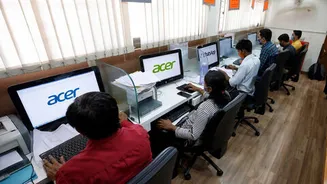
India's professional landscape is set for a massive expansion, with projections showing nearly 48 million office workers by 2030. But as this workforce grows, a powerful new colleague is entering the frame: Artificial Intelligence (AI).
Setting the Stage: A 48 Million Strong Workforce
Recent studies,
including one from Cushman & Wakefield, forecast that India's office-based workforce will swell from around 38 million in 2025 to approximately 48 million by 2030. This growth is largely driven by the continued expansion of IT services and the boom in Global Capability Centres (GCCs), which are increasingly handling high-value work like R&D and product engineering. On the surface, this suggests a straightforward surge in demand for office space. However, this decade-long expansion coincides with the rapid adoption of AI, creating a more complex and nuanced picture of the future workplace.
AI's Dual Impact: Job Automation vs. Augmentation
The fear that AI will simply eliminate jobs and, by extension, the need for offices, is an oversimplification. The reality is more of a transformation. AI is expected to automate many routine, repetitive tasks currently performed by humans in areas like data entry, basic analysis, and back-office support. This is the 'displacement effect'. Yet, for every task it automates, AI also augments human capabilities in more complex roles. Analysts, designers, and strategists can use AI to process vast amounts of data, freeing them up to focus on higher-order thinking, creativity, and decision-making. This shift means companies may hire fewer people for entry-level execution but more for senior-level supervision and strategy. This doesn't necessarily mean a smaller office, but a different kind of office.
The Office Reimagined: From Cubicles to Collaboration Hubs
As AI handles solitary, heads-down tasks, the primary function of the physical office is changing. The future workplace is less about rows of desks and more about creating environments that foster human interaction, innovation, and collaboration. Industry experts predict a 'flight to quality', where demand shifts towards premium, well-designed spaces that can attract and retain top talent. These next-generation offices will feature a mix of dynamic layouts: quiet zones for focused work, advanced tech-enabled meeting rooms for seamless hybrid collaboration, and open, flexible areas designed for spontaneous teamwork. The focus is moving from maximising headcount per square foot to maximising the quality of interaction and employee well_being.
Smarter Buildings, Smarter Decisions
AI's influence extends beyond job roles and into the very bricks and mortar of the office. AI_powered building management systems are making workspaces more efficient, sustainable, and responsive. By analysing real_time data from sensors, these systems can optimise lighting, temperature, and air quality based on occupancy patterns, reducing energy consumption and improving employee comfort. This data_driven approach also allows companies to understand precisely how their space is being used, identifying underutilised areas that can be reconfigured. This move from static layouts to adaptive environments means companies can make smarter, faster decisions about their real estate portfolios, ensuring their space evolves with their needs.
The Real Estate Equation: Not Less Space, But Better Space
So, what is the final verdict for office space demand? While some companies might reduce their overall footprint as certain roles are automated, this is not the whole story. The growth in India's overall workforce, combined with the shift towards higher_value jobs that require collaborative environments, is expected to sustain demand. A recent survey by CBRE found that a majority of office occupiers in India do not expect AI to have a material impact on their immediate leasing decisions. Instead, the focus is on securing high_quality spaces. The rise of leaner, more senior_heavy teams means an increase in the average space required per employee, as collaborative and amenity_rich zones take precedence over dense cubicle farms. The future of Indian office space isn't about disappearing; it's about evolving to become more strategic, flexible, and human_centric than ever before.