


A Rare Glimpse of the Sun’s Ghostly Crown
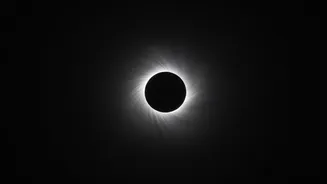
The main attraction for solar researchers is the sun’s outer atmosphere, the corona. Normally, this ethereal halo is completely invisible, drowned out by the sun's overwhelmingly bright surface, called the photosphere. During a total eclipse, the moon
acts as a perfect natural shield, blocking the photosphere and revealing the faint, wispy corona. While scientists have instruments called coronagraphs that can create artificial eclipses, they must block out part of the lower corona to get clear images. A natural eclipse provides the only clear view of this critical region from Earth, which is why these events are so scientifically valuable.
The Coronal Heating Paradox
One of the longest-standing mysteries in astrophysics is the coronal heating problem. Logically, temperatures should decrease as you move away from a heat source. However, the sun defies this logic. Its surface is a searing 6,000 degrees Celsius, but the corona, millions of kilometers above it, sizzles at an astonishing one to three million degrees. Scientists still don't fully understand the mechanism responsible for this superheating. During the 2026 eclipse, researchers will use high-resolution cameras and spectrometers to hunt for clues. They will analyze the light from different elements in the corona, which can reveal temperature data and help test theories about magnetic waves and small-scale explosions, or "nanoflares," that might be pumping energy into the atmosphere.
Chasing the Shadow at 50,000 Feet
To maximize their observation time, a team of NASA-funded scientists will once again take to the skies in a WB-57 high-altitude research aircraft. Flying at 50,000 feet, well above any potential cloud cover, the jet will chase the moon's shadow as it moves across the Atlantic. This aerial pursuit extends the brief window of totality, allowing a suite of advanced cameras in the plane's nose cone to capture more data. These instruments will take rapid, multi-wavelength images of the corona, aiming to spot dynamic changes and study the origins of the solar wind—the stream of charged particles that flows from the sun and influences the entire solar system.
How Does an Eclipse Affect Earth?
The sun’s influence extends directly to our own planet, and an eclipse provides a unique, localized experiment to study that connection. As the moon’s shadow passes, it creates a sudden, temporary drop in sunlight and temperature. In Iceland, teams will launch dozens of scientific balloons before, during, and after the eclipse to measure how this sudden change affects Earth’s boundary layer, the part of the atmosphere closest to the ground. These launches will build on data from previous eclipses, which showed the boundary layer's thickness can change depending on cloud cover. Other projects will monitor the ionosphere, an upper layer of the atmosphere that is charged by solar radiation. Observing how it responds when the sun's energy is briefly blocked helps scientists understand its impact on communications and GPS signals.
Continuing a Legacy of Discovery
Every eclipse is different because the sun is a dynamic, constantly changing star. Its magnetic field, which shapes the corona’s appearance, is always in flux. The 2026 eclipse offers a unique snapshot in the life of our sun. Eclipse observations have historically led to major breakthroughs, including the discovery of the element helium in 1868 and a key confirmation of Einstein's theory of general relativity in 1919. While some teams will focus on the corona, others may use the darkened sky to test new instruments or even replicate that famous relativity experiment. The data gathered in these precious minutes of totality will help refine models of space weather, improve our ability to protect satellites and astronauts, and push us closer to understanding the fundamental physics of our star.