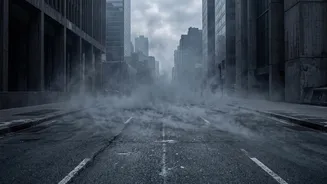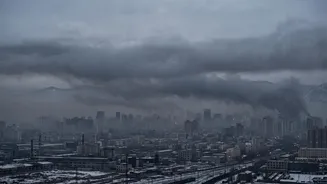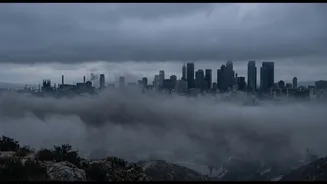






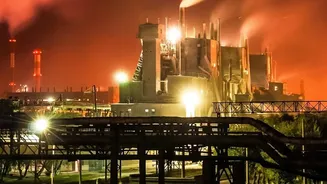
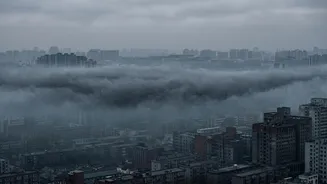
Every winter, residents of major Indian cities notice a familiar, troubling pattern: the air quality plummets as evening sets in. This isn't just a coincidence. A daily atmospheric event known as a 'boundary layer collapse' is a primary culprit.
The Atmosphere's Breathing Room
To understand
what happens, first picture the 'planetary boundary layer' (PBL). It's the lowest part of the atmosphere, the layer we live and breathe in, which is in direct contact with the Earth's surface. During the day, the sun heats the ground, which in turn warms the air above it. This warm air rises, creating turbulence and mixing that allows pollutants to disperse upwards into a larger volume of atmosphere. Think of it as the atmosphere having a high ceiling, giving pollution plenty of room to spread out and dilute. This daytime boundary layer can be a kilometre deep or even more.
The Daily Cycle of Expansion and Contraction
The height of this boundary layer isn't static; it follows a daily rhythm. It grows, or expands, throughout the day as solar radiation warms the planet's surface. This process, known as convection, involves large eddies of air that cycle and mix the atmosphere. This vertical mixing is crucial for air quality. It acts like a giant, invisible fan, carrying pollutants from street level high up into the troposphere, where they are scattered. However, as the sun begins to set, this entire process reverses.
What 'Collapse' Really Means
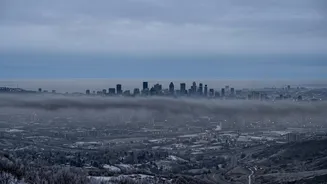
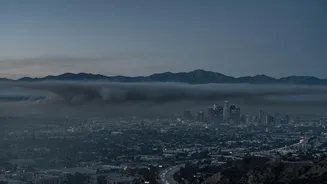
As sunset approaches, the ground rapidly loses heat. The air closest to the surface cools down quickly, becoming denser and heavier than the air just a few hundred metres above it. This creates a 'temperature inversion'—a stable layer of warmer air sitting on top of cooler air like a lid on a pot. This inversion stops the vertical mixing of air. With the convective turbulence gone, the boundary layer is said to 'collapse', shrinking dramatically from a height of a kilometre or more to just a few hundred metres, sometimes as low as 100 metres.
Trapping Pollutants Under a Lid
This collapse is what makes evening and nighttime air quality so hazardous. All the pollutants emitted throughout the day—from vehicles, industry, construction, and biomass burning—are suddenly trapped in a much shallower layer of air. The 'ceiling' has been lowered, but the sources of pollution are still pumping out emissions. The same quantity of particulate matter and toxic gases gets concentrated in a fraction of the atmospheric volume, causing ground-level concentrations of PM2.5 and other pollutants to spike dramatically. It’s not necessarily that more pollution is being created at 7 PM, but that the atmosphere’s ability to disperse it has vanished.
India's Compounding Factors
In North Indian cities, especially across the Indo–Gangetic Plain, this phenomenon is intensified by several factors. The region's geography, a 'bowl' flanked by the Himalayas, restricts wind flow. During the post–monsoon and winter months, wind speeds are naturally low, preventing pollutants from being blown away horizontally. This stagnation, combined with massive pollution sources like agricultural stubble burning in neighbouring states and high urban emissions, creates a perfect storm. The boundary layer collapses, trapping this thick cocktail of pollutants and leading to the severe, multi–day smog episodes that have become an annual public health crisis.