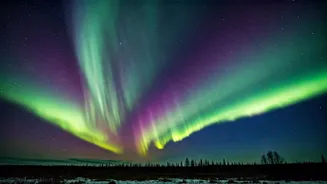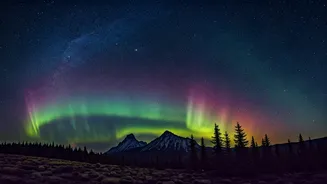




So, What Is the Aurora?
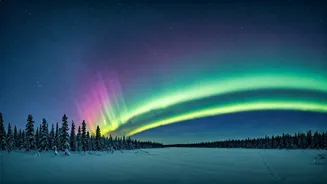
In the simplest terms, the aurora is a beautiful collision. It starts 93 million miles away, at the sun, which is constantly sending a stream of charged particles called solar wind into space. When that wind hits Earth, our planet’s magnetic field funnels
the particles toward the North and South Poles. There, they crash into gases like oxygen and nitrogen in our upper atmosphere. The result of this high-energy collision is light. The color depends on the gas and the altitude of the collision: oxygen typically glows green (the most common color) or red, while nitrogen can produce blues and purples. Think of it as a massive, natural neon sign, switched on by the sun, with Earth’s atmosphere as the bulb.
Why Is This Happening Now?
The sun has an 11-year cycle of activity, moving from a quiet period (solar minimum) to a turbulent one (solar maximum). We are currently entering a solar maximum for what scientists call Solar Cycle 25, and it’s expected to be stronger and peak sooner than originally forecasted. A more active sun means more frequent and powerful solar flares and coronal mass ejections (CMEs)—giant eruptions of plasma and magnetic fields from the sun's surface. When a CME is aimed at Earth, it can trigger a geomagnetic storm that dramatically intensifies the aurora, making the lights brighter and pushing them much further south than usual. This is why people in states like Colorado, Illinois, and even northern California have reported sightings in the past year. This peak activity period gives millions of Americans their best chance in over a decade to witness the phenomenon.
The Aurora Hunter’s Checklist
Seeing the aurora is part science, part luck. You can’t just walk outside and expect a show. But you can dramatically increase your odds by planning ahead. First, you need a strong forecast. The best free resource is NOAA’s Space Weather Prediction Center. Their 30-minute aurora forecast shows a real-time map of the aurora’s reach. Look for a high Kp-index, a scale from 0 to 9 that measures geomagnetic activity. A Kp of 5 can mean visible aurora in northern states like Montana and Minnesota; a Kp of 7 or higher could bring the show to the Midwest and beyond. Second, you need darkness. This means getting away from city lights, which will wash out all but the most intense auroras. Use a dark sky map to find a state park or rural area with a clear, unobstructed view of the northern horizon. The best viewing times are typically between 10 p.m. and 2 a.m. local time, and you’ll want to go on a night with a new moon or when the moon has already set.
Where to Go in the United States
While a major storm can bring the lights surprisingly far south, your best bet is still to be in the northern tier of the country. Alaska is, of course, the gold standard. But within the Lower 48, several states offer prime viewing opportunities during this solar maximum. * **The Upper Midwest:** Minnesota’s North Shore of Lake Superior, Michigan’s Upper Peninsula (especially Headlands International Dark Sky Park), and northern Wisconsin are classic aurora-hunting grounds. * **The Northeast:** Northern Maine (like Aroostook County), New Hampshire’s White Mountains, and Vermont’s Northeast Kingdom offer dark skies and northern latitudes. * **The West:** Idaho’s panhandle, Montana (Glacier National Park is ideal), North Dakota, and Washington state (especially the North Cascades) are all fantastic locations. Remember to check local weather—clouds are the ultimate enemy of the aurora hunter.
How to Photograph the Lights
You don't need to be a professional photographer to capture the aurora. Modern smartphone cameras are surprisingly capable. The key is stability and a long exposure. * **For any camera:** Use a tripod. Any slight movement will result in a blurry mess during a long exposure. * **On a smartphone:** Use Night Mode if you have it. If not, download an app that allows manual controls. You’ll want to set the shutter speed to be open for several seconds (start with 5-15 seconds) and increase the ISO (the camera’s sensitivity to light) to around 800 or 1600. Use a self-timer to avoid shaking the phone when you press the button. * **On a DSLR or mirrorless camera:** Use a wide-angle lens with a fast aperture (f/2.8 or lower is ideal). Set your focus manually to infinity. Start with a shutter speed of 10-20 seconds and an ISO of 1600-3200, then adjust based on the brightness of the aurora.