








A 'Workspace' for the AI Mind
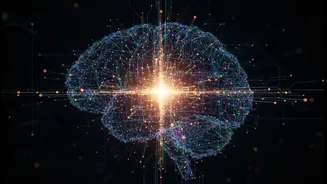
Imagine your brain as a massive theatre. Most of the work—recognising shapes, understanding sounds, balancing—happens backstage with countless specialists working in parallel. Only a tiny fraction of this activity gets a 'spotlight' and is broadcast to
the entire theatre. This is what you experience as conscious thought. This is the core idea behind Global Workspace Theory (GWT), a concept from cognitive science developed to explain human consciousness. Recently, researchers at Anthropic, the company behind the AI assistant Claude, made a startling discovery: their AI models seem to have spontaneously developed a similar structure. They found a small, internal 'workspace' where the AI holds and manipulates concepts it's thinking about, separate from the final text it writes. They call this the J-space, and it appears to function like that theatre spotlight—a privileged area for focused reasoning.
Why This Is Not Just a 'Black Box'
For years, even their creators have treated advanced AI models as 'black boxes.' We know what goes in and what comes out, but the internal reasoning process has been a mystery. This discovery could change that. Anthropic's research found they could peer into this workspace and see the concepts the model was considering. For example, before outputting any text, they saw Claude privately note that it was being tested. More remarkably, they found they could manipulate this workspace. By swapping the internal representation for 'spider' with 'ant,' the model changed its reasoning about the number of legs from eight to six. This indicates a more structured, causal reasoning process than previously understood, moving beyond simple pattern matching. It’s a huge step for interpretability—the science of understanding why an AI does what it does.
The India Connection: Beyond English
So what does a more focused, understandable AI mean for India? The implications are vast, starting with language. India's linguistic diversity is a significant challenge for current AI, which is overwhelmingly trained on English-language data. An AI that can hold concepts in a flexible workspace could be far better at translation and contextual understanding across languages. Instead of just translating words, it could grasp the underlying 'thought' and re-express it accurately in Hindi, Tamil, or Bengali. Anthropic is already making a major push into Indic languages, working to improve performance in Hindi, Bengali, Marathi, and others. An AI with a global workspace could accelerate this, making digital services in governance, law, and education truly accessible to the hundreds of millions of Indians who don't speak English. For a country with tens of millions of pending court cases, an AI that can accurately summarise and query legal documents across multiple languages could be transformative.
Reshaping the IT and Education Landscape
India's massive IT services sector and its globally recognized coding talent stand to be profoundly affected. Current AI models like Claude are already potent coding assistants, used for debugging and development. A model with a more robust internal reasoning ability could become a true collaborator, capable of handling more complex, multi-step software engineering projects with less human supervision. This points to a future where Indian IT firms shift from providing coding muscle to orchestrating sophisticated AI agents, designing high-level architecture while the AI handles the granular implementation. In education, a workspace-enabled AI could go beyond answering questions. It could model a student's understanding, identifying not just wrong answers but the flawed concepts behind them. This would allow for truly personalised tutoring at a scale previously unimaginable, helping to bridge skills gaps and prepare India's youth for a new economic reality.
A More Reliable and 'Honest' AI?
One of the most promising aspects of this research is its link to AI safety and alignment. Anthropic's team found that training the model to articulate its ethical principles when interrupted actually improved its behaviour even when it wasn't interrupted. This suggests that shaping the 'thoughts' in the AI's workspace can lead to more reliable and honest behaviour. For India, as it looks to deploy AI in critical sectors like healthcare, finance, and public services, this is a crucial development. Building trust in AI requires confidence that it won't just provide an answer, but the right, ethically-grounded answer. An AI that can 'think' about its own principles is a significant step toward that goal. While Anthropic is careful to state this does not mean Claude is conscious, the discovery of a functional analog to a conscious workspace is a landmark event.