
A New Window on the Cosmic Dawn
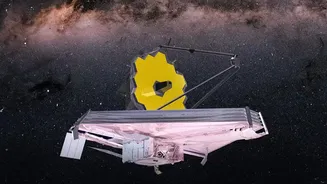
The James Webb Space Telescope (JWST) is not just another telescope; it's a specialised instrument designed to see the universe in infrared light. This is crucial because, as the universe expands, light from the most distant objects gets stretched out,
shifting it from visible light into the infrared spectrum. This allows Webb to see what other telescopes, like Hubble, could not: the faint glow of the first galaxies that formed a few hundred million years after the Big Bang. This period, known as the cosmic dawn, was when the universe emerged from a dark, foggy state to one filled with light and structure. By capturing this ancient infrared light, JWST is providing the most detailed view of this transformative era ever achieved.
Peering into Galactic Nurseries
Recent findings, particularly from the JWST Advanced Deep Extragalactic Survey (JADES), have stunned astronomers. Where they expected to see small, tentative beginnings of galaxy formation, they found something far more dynamic. The telescope has identified hundreds of galaxies that existed when the universe was less than 600 million years old, a number far exceeding predictions. These weren't just smudges of light; the crispness of Webb's imaging shows distinct structures and intense hotspots of activity. These bright clumps are stellar nurseries, regions where dense clouds of gas are collapsing to create new stars at an astonishing rate. Almost every galaxy observed from this era shows signatures of incredibly intense, recent star formation.
A Universe of 'Bursty' Star Formation
The key insight from these new observations is how these early stars were made. Instead of forming stars at a slow and steady pace like our own Milky Way does today, these primordial galaxies were 'bursty'. They went through rapid, explosive periods of star creation, generating millions of hot, massive stars in a relatively short cosmic timeframe. This burstiness was particularly common in the low-mass galaxies of the high-redshift (very distant) universe. This helps solve a major puzzle: how galaxies grew so large, so quickly. The early universe appears to have been much more efficient at turning gas into stars than previously thought, leading to a much more rapid assembly of the galactic structures we see today.
Hidden Stars and Bigger Galaxies
Another surprising discovery is what kinds of stars these early galaxies were making. Astronomers long assumed that the distribution of star sizes was roughly the same everywhere. However, recent JWST data suggests that early galaxies may have produced a much larger population of faint, low-mass stars than previously accounted for. While the giant, bright stars are easier to see, these smaller stars were hidden from view. The implication is profound: these early galaxies could be up to four times more massive than earlier estimates suggested. This finding deepens the mystery of the early cosmos, challenging models that struggle to explain how such enormous structures could have assembled so quickly after the Big Bang.
Rewriting the Story of Our Universe
Together, these discoveries are forcing scientists to rethink fundamental theories of galaxy evolution. The universe appears to have become structured and luminous much faster than predicted. The evidence of widespread, bursty star formation explains how the cosmic fog of the dark ages was cleared out, a process called reionization, which made the universe transparent to light. The massive, hot stars in these early galaxies pumped out enough ultraviolet radiation to ionize the surrounding neutral gas, transforming the cosmos. With every new image, the James Webb Space Telescope is not just confirming theories but actively rewriting the first chapter of our universe's history.