


What Is a Planetary Convergence?
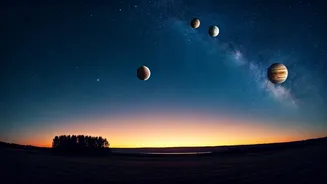
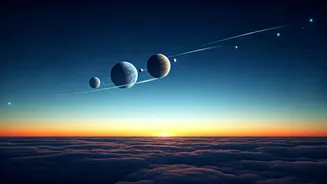
When we say planets are 'converging' or 'in conjunction', it doesn't mean they are physically close to each other in space. In reality, they remain millions of kilometres apart, each following its own massive orbit around the Sun. What we are witnessing
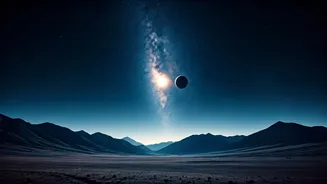
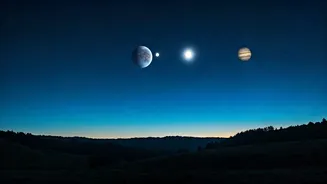
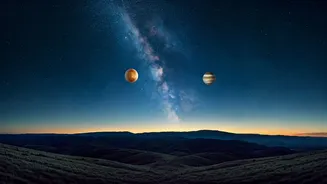
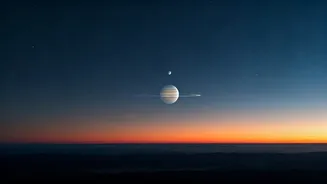
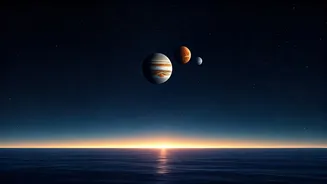
is a beautiful illusion of perspective. From our viewpoint on Earth, their orbital paths cause them to appear grouped together in a small patch of our sky. This alignment is often called a planetary conjunction. While two-planet conjunctions are relatively common, seeing a trio of bright planets like Mercury, Venus, and Jupiter huddled together is a much rarer and more captivating sight. Tonight’s event brings together the brightest planet (Venus), the largest planet (Jupiter), and the fastest-orbiting planet (Mercury) into a single frame.
Your Guide to Watching in India
The good news is you don't need any special equipment to see this cosmic show. All three planets are bright enough to be visible to the naked eye. The key is timing and location. The best time to look is shortly after sunset. Aim for about 30 to 45 minutes after the sun has dipped below the horizon, during the twilight hour. Find a spot with an unobstructed view of the western sky, as the planets will be low on the horizon. From cities like Delhi, Mumbai, Bengaluru, and Kolkata, the viewing window will be brief—perhaps only an hour or so before the planets themselves set. Venus will be the easiest to spot; it's the most brilliant point of light in the evening sky. Jupiter will appear slightly fainter, and Mercury, being closest to the horizon and the dimmest of the three, will be the most challenging to find.
Meet the Stars of the Show
Get to know the planets you'll be watching. Venus, often called the 'Evening Star' or 'Morning Star', is the second planet from the Sun and is shrouded in thick, reflective clouds, which is why it shines so brightly. It's the brightest object in our night sky after the Moon. Jupiter, the fifth planet, is a gas giant and the largest planet in our solar system. Its immense size makes it one of the brightest objects in the sky, easily outshining all the stars. Finally, there's Mercury. As the planet closest to the Sun, it’s often lost in the solar glare, making it a tricky catch. Seeing Mercury is a real treat for any sky-watcher, and having it appear alongside Venus and Jupiter makes this event particularly special.
Tips for the Best Viewing Experience
To make the most of this celestial gathering, follow a few simple tips. First, get away from city lights if you can. Light pollution washes out fainter objects, and finding a darker location will make the planets pop against the deepening twilight. Second, give your eyes time to adjust to the dark—it can take up to 20 minutes for them to become fully sensitive. Third, while you don't need a telescope, a pair of binoculars will dramatically enhance the view. With binoculars, you might even be able to glimpse Jupiter’s four largest moons—Io, Europa, Ganymede, and Callisto—appearing as tiny pinpricks of light flanking the giant planet. Finally, consider using a stargazing app on your phone. Apps like Stellarium or SkyView can help you pinpoint the exact location of the planets in the sky from your specific location.