






Meet the PJ.2.1 Variant
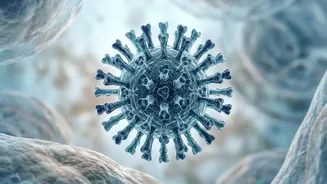
PJ.2.1 is the latest offshoot of the widespread JN.1 family, which has been the dominant global lineage of SARS-CoV-2. Scientists are paying attention to it for a specific reason: it's what they call a 'saltation variant'. This means that instead of evolving
slowly by picking up a few mutations over time, it appeared with a large number of genetic changes all at once, particularly in its spike protein. The spike protein is the key the virus uses to unlock and enter our body's cells. PJ.2.1 carries over 25 mutations in this critical area. Since its initial detection in Canada, cases have been identified in the United States, several European countries, and parts of Asia and Australia.
A Different Way of Attacking Cells
The main concern with any new variant is whether its mutations give it an advantage. Early lab studies on PJ.2.1, including one published in the Journal of Infection, have revealed an interesting trait. The variant appears to bind more strongly to the ACE2 receptor, which is the main doorway SARS-CoV-2 uses to enter human cells. Think of it as having a more efficient key. This enhanced binding ability could be what is helping the variant to spread, as it may be better at infecting cells, even those with few ACE2 receptors. However, scientists are cautious to note that findings in a lab do not always translate to increased transmissibility in the real world.
How Do Our Antibodies Hold Up?
The most pressing question for most people is whether immunity from past infections or vaccinations still works. On this front, the news is reassuring. The same laboratory studies that highlighted PJ.2.1's stronger binding also looked at how it fares against our immune system's antibodies. They found that the variant does not show a significant ability to evade the antibodies generated by updated vaccines. Research showed that antibodies from people who received a modern LP.8.1-adapted vaccine could successfully neutralise PJ.2.1. While there was a slight reduction in effectiveness compared to the vaccine's original target, it was not a dramatic loss of protection. This suggests that while the virus has changed its key, our immune system's security guards can still recognise the intruder.
No Evidence of More Severe Disease
Increased spread does not automatically mean more severe illness. Currently, there is no clinical evidence to suggest that PJ.2.1 causes more severe COVID-19, higher rates of hospitalisation, or more deaths than other circulating variants. The symptoms associated with PJ.2.1 are the familiar ones: fever, cough, sore throat, body aches, and fatigue. Some reports suggest it may lead to more severe throat infections or prolonged fatigue, but this is based on preliminary observations. Public health experts stress that while the new variant warrants monitoring, there is no cause for alarm. The virus is still around, but hospitals are not reporting the same level of severity seen in the pandemic's early years.
What This Means for India
As of mid-November 2026, the PJ.2.1 variant has not been officially reported in India, but global spread means its arrival is possible. The key takeaway from the current research is that viral evolution is an ongoing process. Variants will continue to emerge, and our immune response, bolstered by updated vaccines and prior infections, continues to adapt. The fundamental advice from health experts remains unchanged: stay up to date with recommended vaccinations, practice good hygiene, and isolate if you feel sick to protect those around you. Vulnerable populations, such as the elderly and those with compromised immune systems, should remain particularly cautious. Keeping an eye on new variants is part of the new normal, but it is a task for scientists and public health bodies, not a reason for public panic.