







The Longest Nap
On June 23, 2026, flight controllers at the Johns Hopkins Applied Physics Laboratory (APL) in Maryland received a signal they had been waiting nearly a year for. The signal, which took almost nine hours to cross the 9.5 billion kilometres to Earth, confirmed
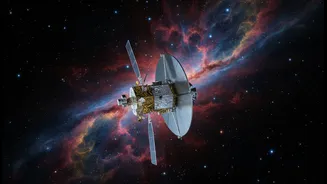
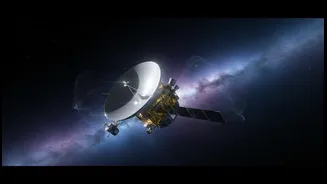
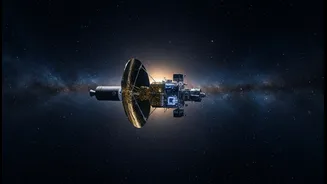
that New Horizons had successfully awakened from its longest-ever hibernation period. Mission teams routinely place the spacecraft in this power-saving mode during long cruise phases to conserve its resources. While most systems power down, a few key science instruments continue to collect data around the clock, essentially allowing the probe to sleep with one eye open. According to Mission Operations Manager Alice Bowman, every weekly status report during the slumber was 'green,' indicating the spacecraft remained in perfect health.
A Journey for the History Books
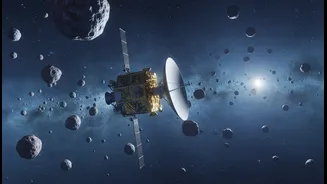
Launched in 2006, New Horizons holds the record for the highest launch velocity for a human-made object from Earth. Its primary mission was the first-ever exploration of Pluto. In July 2015, after a nine-year voyage, it flew past the dwarf planet, sending back breathtaking images and data that revolutionised our understanding of these distant worlds. But its work wasn't done. On January 1, 2019, New Horizons flew by Arrokoth, a snowman-shaped object in the Kuiper Belt, making it the most distant object ever explored up close. The Kuiper Belt is a vast, donut-shaped ring of icy bodies circling the outer solar system beyond Neptune, a relic from the formation of our solar system.
A New Mission at the Edge of the System
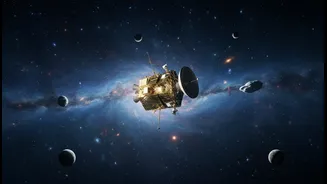
Now, more than a decade after its historic Pluto encounter, New Horizons has a new role: a deep-space observatory. Instead of preparing for another flyby, its mission has been extended to study the outer heliosphere—the vast magnetic bubble created by the stream of charged particles flowing from the sun, known as the solar wind. Its instruments, like the Solar Wind Around Pluto (SWAP) and the Pluto Energetic Particle Spectrometer Science Investigation (PEPSSI), have been quietly measuring this environment. Now that it is awake, the spacecraft will begin the long process of transmitting this valuable data back to Earth. In a few weeks, its ultraviolet spectrograph, named Alice, will also begin observing how hydrogen gas is distributed at these extreme distances.
What Comes Next for the Intrepid Explorer?
New Horizons continues to speed away from us at a rate of about 480 million kilometres per year. Its current extended mission is focused on heliophysics, providing a unique vantage point that no other active mission can offer. The data it collects helps scientists understand where the Sun's influence ends and interstellar space begins, a boundary known as the termination shock. This cosmic puzzle is not just about our own star; it provides a model for understanding the astrospheres around other stars in the galaxy. The team is also using powerful ground-based observatories to search for another potential Kuiper Belt object for New Horizons to visit, though finding a suitable target within its reach is a challenge. Even without another flyby, the spacecraft is expected to keep returning data for years to come, pushing the boundaries of what we know about our place in the universe.