






The Fiery Problem of Reentry
When the Gaganyaan crew module returns from orbit, it will slam into the upper atmosphere at speeds of over 28,000 kilometres per hour. This incredible velocity compresses the air in front of it, creating a superheated plasma sheath with temperatures
soaring to 1,800°C. More than 99% of the spacecraft's kinetic energy is converted into intense heat. Without protection, the module would be instantly incinerated. The headline also mentions "post-abort reentry," a critical scenario where astronauts must be brought back safely not just at the end of a mission, but also if an emergency occurs shortly after launch. This requires a heat shield robust enough to handle various trajectories and extreme conditions, making its testing paramount.
The Sacrificial Shield
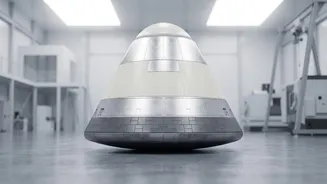
ISRO’s solution is an ablative Thermal Protection System (TPS). Think of it as a sacrificial shield. Made from materials like carbon phenolic and silica phenolic composites, this 30-35 mm thick layer is designed to burn away in a controlled manner. As the outer surface chars and vaporises, a process called pyrolysis, it carries the extreme heat away from the capsule. The escaping gases also form a protective boundary layer, pushing the hottest plasma away from the module's structure. This method, proven in ISRO's earlier Space Capsule Recovery Experiment (SRE) and the 2014 CARE mission, ensures that while the exterior faces scorching temperatures, the internal structure remains below 150°C.
Forging a Shield on the Ground
Before trusting the heat shield in a real flight, ISRO must prove it can withstand reentry conditions. This starts on the ground in a plasma wind tunnel. This facility recreates the hellish environment of atmospheric entry by generating a jet of superheated, high-velocity plasma. Material samples and prototypes of the heat shield are placed inside this jet to study their performance. Engineers meticulously measure how much the material erodes (surface recession) and how much heat gets through to the other side. By subjecting candidate materials like Carbon Phenolic (CP) and Silica Phenolic (SP) to the expected peak heat, ISRO can select the best-performing composite for the job, ensuring reliability before a single component is built for the actual crew module.
Taking the Plunge: Integrated Air Drop Tests
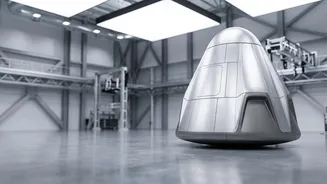
While ground tests are crucial, nothing beats a real-world demonstration. ISRO conducts a series of Integrated Air Drop Tests (IADT) to validate the entire return sequence. In these tests, a simulated crew module, weighing over 5 tonnes, is lifted by an Indian Air Force Chinook helicopter to an altitude of around 3 kilometres and dropped. This test isn't just about the heat shield, but about the entire system working in concert. It validates the complex sequence of parachute deployments—from the small pilot chutes that pull out the larger drogue and main parachutes—which are essential for slowing the module down after it has passed through the main heating phase of reentry. Successful tests, like IADT-01 and IADT-02, demonstrate that the capsule can be safely decelerated for a gentle splashdown.
Simulating Every Possibility
The testing regimen covers a wide range of mission scenarios, especially aborts. The Pad Abort Test, for example, validated the Crew Escape System's ability to pull the module away from a malfunctioning rocket on the launchpad. Other tests verify that the crew module separates cleanly from its service module before reentry and that the apex cover, which protects the parachutes, jettisons correctly without damaging the capsule. Every single step, from the initial separation in orbit to the final splashdown, is simulated and tested with massive safety margins. This thoroughness ensures that no matter when an abort is triggered, the systems designed to bring the crew home will function flawlessly.