





What is a Sample-Return Mission?
A sample-return mission is one of the most complex feats in space exploration. While landing a craft on another celestial body is a massive achievement, returning it to Earth is exponentially harder. It involves landing, collecting materials, launching
off the lunar surface, journeying back to Earth, and surviving a fiery atmospheric re-entry. Only three countries have ever accomplished this: the United States, the former Soviet Union, and China. If successful, Chandrayaan-4 would place India in this elite group, marking a monumental leap in the nation's space capabilities. The mission's primary objective is to collect samples of lunar soil, or regolith, and return them safely to Earth for detailed scientific study.
The Target: Precious Lunar Ice
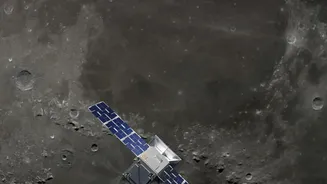
The real prize for Chandrayaan-4 lies in the permanently shadowed regions of the Moon's south pole. Data from previous missions, including Chandrayaan-2, suggests these frigid craters may hold significant deposits of water ice. This ice is considered a crucial resource for future space exploration. Analysing it on Earth could unlock secrets about the origin of water in our solar system. More practically, lunar ice could one day be mined and processed into breathable air, drinking water, and even rocket fuel (hydrogen and oxygen), which would be essential for establishing a long-term human presence on the Moon and for missions to Mars and beyond.
A Complex Five-Module Design
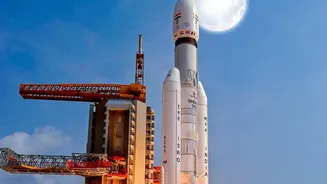
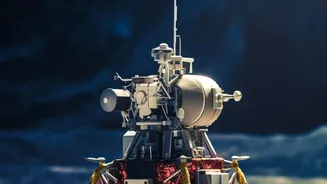
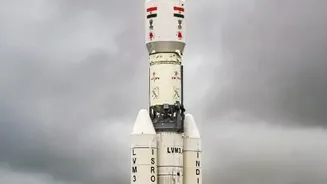
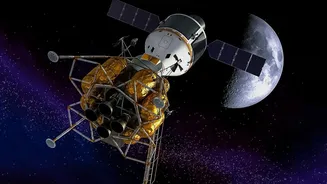
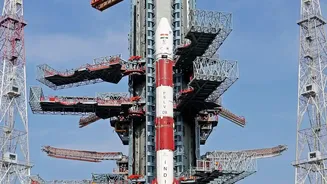
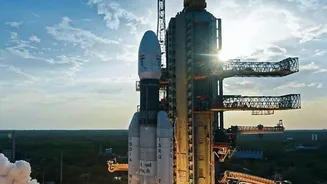
Chandrayaan-4 is far more complex than its predecessors, requiring five separate modules. Because the combined spacecraft is too heavy for a single rocket, ISRO plans to use two LVM3 launch vehicles. The first rocket will launch the Descender Module (for landing) and the Ascender Module (for lifting off from the Moon). The second rocket will carry the Propulsion Module, Transfer Module, and the all-important Re-entry Module that will bring the samples back. These two stacks will then perform a complex docking manoeuvre in Earth's orbit—a feat India has been practicing with its SPADEX mission—before the integrated spacecraft begins its journey to the Moon.
How the Mission Will Unfold
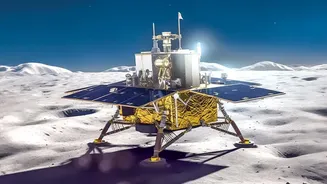
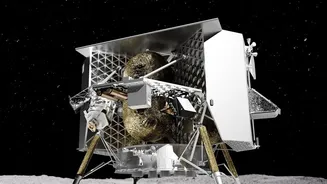
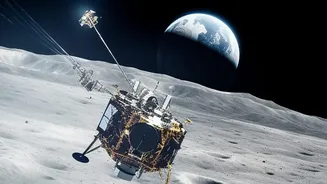
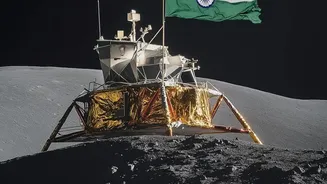
Once in lunar orbit, the lander and ascender will separate and perform a soft landing near the south pole. On the surface, a robotic arm and a drill will collect several kilograms of both surface soil and sub-surface samples, which will be sealed in containers to prevent contamination. At the end of the lunar day, the Ascender Module will fire its engines, lifting off from the Moon to rendezvous and dock with the Transfer and Re-entry modules waiting in lunar orbit. The precious samples will be transferred to the Re-entry Module, which will then be guided back to Earth. The final, nail-biting step will be the module's high-speed entry into Earth's atmosphere for a safe landing.
Challenges and Timeline
The mission, approved by the Union Cabinet in September 2024, is a showcase of high-end technology. Key challenges include mastering in-orbit docking, automated sample collection, and—most critically—the lunar ascent and the high-velocity return to Earth. While initially planned for a 36-month timeline, ambitious missions like this often face adjustments. ISRO officials are currently targeting a launch around 2028. This mission not only builds on the soft-landing success of Chandrayaan-3 but also paves the way for even more ambitious projects, such as the LUPEX mission with Japan's space agency (JAXA) to further explore lunar water ice.