


The Sun's Hidden Gearbox
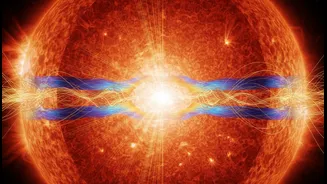
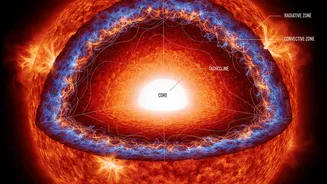
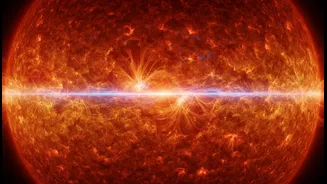
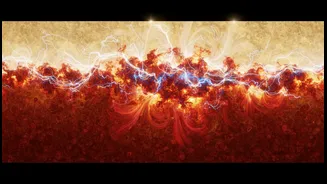
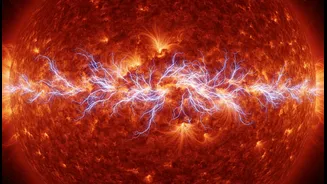
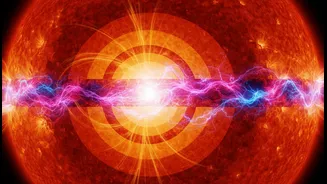
This mysterious region is called the tachocline. Think of it as a crucial boundary layer deep within our star. Below it, the Sun’s vast inner radiative zone rotates like a solid, unified ball. Above it, the turbulent outer convection zone churns like a boiling
pot of water, with the equator spinning much faster than the poles. The tachocline is the incredibly thin, intensely sheared layer that separates these two dramatically different rotation styles. It’s a place of immense physical stress, and for decades, scientists have wondered how it can exist at all. Standard models of fluid dynamics suggested that this sharp boundary should blur and thicken over time, but helioseismology—the study of the Sun's interior using wave oscillations—shows it remains remarkably crisp, less than 5% of the Sun's radius in thickness.
The Engine of the Solar Cycle
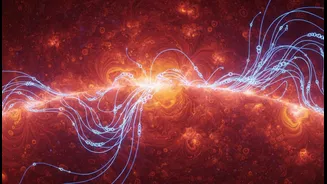
The reason this thin layer is so important is because it’s believed to be the heart of the solar dynamo—the process that generates the Sun’s massive and complex magnetic field. The intense shearing motion within the tachocline is thought to stretch, twist, and amplify magnetic fields, building up huge amounts of energy. This stored energy is eventually released, bubbling up to the surface to create sunspots and powering dramatic events like solar flares and coronal mass ejections (CMEs). These events are the main drivers of space weather, which can have significant impacts here on Earth, threatening satellites, power grids, and communication systems. Therefore, understanding the tachocline isn't just an academic exercise; it's fundamental to predicting the Sun's behaviour and protecting our technology-dependent world.
A Breakthrough in a Virtual Sun
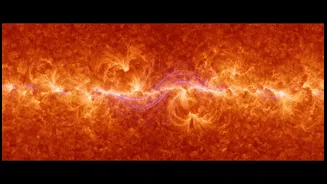
The main challenge in studying the tachocline is that it is impossible to observe directly. Scientists must rely on indirect methods and, increasingly, on sophisticated computer models. For years, simulations struggled to replicate the tachocline’s persistent thinness. However, recent advancements in supercomputing have changed the game. Researchers, including teams supported by NASA's COFFIES (Consequences of Fields and Flows in the Interior and Exterior of the Sun) initiative, have developed state-of-the-art models that can simulate the complex interplay of plasma flows and magnetic fields with unprecedented realism. A key finding from these simulations is that the magnetic field isn't just a product of the tachocline; it’s also the very thing that keeps the layer so thin. Fluctuating magnetic forces appear to act as a kind of 'containment' mechanism, preventing the shear layer from spreading out.
Solving a Decades-Old Puzzle
These new models are a major leap forward because, for the first time, a stable, thin tachocline has emerged spontaneously within a simulation without being artificially forced by the programmers. This suggests the models are accurately capturing the essential physics at play. The breakthrough simulations show that a complex dance between fluid dynamics and magnetism is responsible for the tachocline's stability. While some debate remains—with some models suggesting the dynamo may originate closer to the surface—strong new evidence points to the tachocline as the deep-seated origin. This emerging consensus helps resolve a long-standing puzzle in solar physics and provides a more solid foundation for understanding how stars like our Sun generate their magnetic cycles.