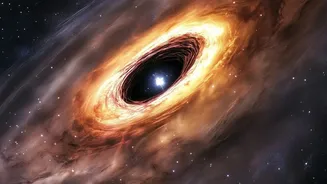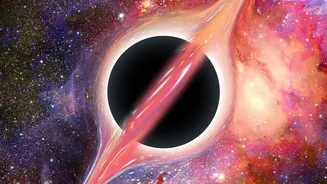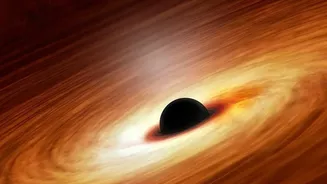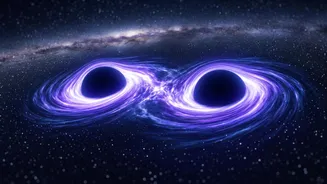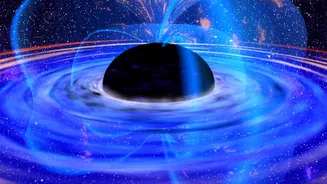





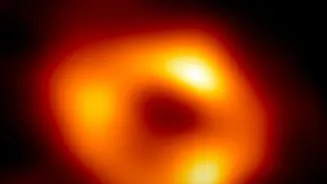
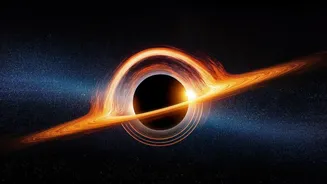
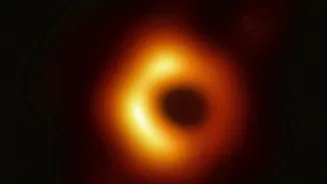
Black holes are famous for pulling things in, not breaking apart. We know they can merge to form bigger ones, but could one ever split into two? New research explores the mind-bending physics that might just allow for this cosmic division.
The Unbreakable Rule of Black Holes
For decades,
the consensus in physics has been that black holes are a one-way street. Their immense gravitational pull, so strong that not even light can escape, means they grow by consuming matter or by merging with other black holes. This idea is supported by fundamental principles of physics, including Stephen Hawking's area theorem, which suggests the total surface area of a black hole's event horizon—its point of no return—cannot decrease. Splitting a single black hole into two smaller ones would seemingly violate this, as the combined area of the two new event horizons could be less than the original. This is largely due to a concept called entropy, a measure of disorder. For a stationary black hole, a split would decrease its entropy, which is forbidden by the second law of thermodynamics, making such a split thermodynamically unfavorable.
A Loophole Involving Extreme Spin
A new theoretical study, published in the journal Physical Review D, proposes a fascinating loophole. Researchers from institutions including the University of Southern Denmark investigated what would happen if a black hole was not stationary, but instead spinning at an incredibly high speed. According to their calculations, the immense rotational energy could change the thermodynamic rules. If a black hole spins fast enough—close to its maximum possible rate—it may become thermodynamically favorable for it to divide into two. This process would cause the event horizon to deform into a bizarre shape described by the study's authors as a 'pair-of-pants topology', where the single black hole stretches and splits into two 'legs', each containing a new, smaller black hole.
The Catch: Escaping Each Other's Grip
Even if a black hole spins fast enough to theoretically allow a split, there is another major hurdle. The two newly formed black holes would be incredibly close to each other, and their own powerful gravity would immediately pull them back together into a merger. For the split to be successful, the two 'daughter' black holes must be able to move away from each other fast enough to escape this fate. According to the research, this crucial condition narrows the possibility almost completely. The only scenario where this might occur is if the original black hole was rotating at the absolute maximum physical limit. This makes the event extraordinarily rare, even in theory.
Why Haven't We Seen This Happen?
To be clear, no observation has ever confirmed a black hole splitting. It remains a purely theoretical concept. The conditions required are so extreme that finding a real-world example would be incredibly difficult. However, the scientists behind the study suggest that it may be possible to find indirect evidence. They propose that small, primordial black holes, theorised to have formed in the early universe, might be more prone to splitting than the large ones we typically observe. If these smaller splits occur, they could release signals, such as bursts of gamma rays, that could potentially be detected by telescopes like NASA's Fermi-LAT. Such a detection would not only confirm the theory but also provide new insights into how gravity works beyond Einstein's current theory.
Pushing the Boundaries of Physics
While the image of a black hole dividing like a cell is captivating, the real value of this research lies in testing the limits of our known physical laws. By exploring such extreme and unlikely scenarios, physicists can better understand the interplay between general relativity and thermodynamics. The study also considered more exotic possibilities, such as how the presence of extra spatial dimensions—predicted by some theories—could make it easier for black hole–like objects to become unstable and decay. Though we are a long way from witnessing a black hole give birth to twins, these theoretical explorations are vital for pushing the boundaries of cosmology and revealing the deeper, stranger rules that govern our universe.