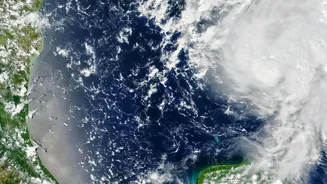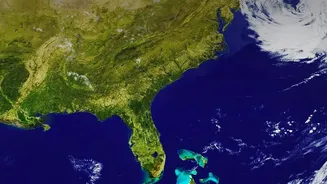





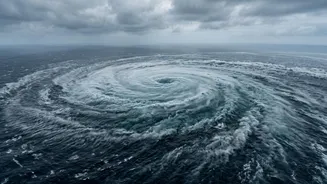
It seems like every year, the cyclones that hit our coasts are fiercer and more destructive. It’s not just your imagination. Scientists are confirming this trend, uncovering a complex picture of why some storms are intensifying, and why it matters.
The Ocean as an Engine
Think
of a tropical cyclone as a giant heat engine. Its fuel is warm, moist air over tropical waters. For a cyclone to form and strengthen, sea surface temperatures generally need to be above 26.5 degrees Celsius. Climate change, driven by the emission of greenhouse gases, is warming our oceans. This means the layer of warm water at the ocean's surface is not only getting hotter, but also deeper. This supercharges the engine. With more thermal energy available, a developing storm can pull in more heat and moisture, converting that power into faster wind speeds and a more formidable, intense cyclone. Essentially, we are providing a richer fuel source for these natural phenomena, allowing them to reach power levels that may have been less common in the past.
A Warmer, Wetter Atmosphere
The impact of rising temperatures is twofold. A warmer atmosphere can also hold more moisture. For every degree Celsius of warming, the air can hold about 7% more water vapour. When a cyclone forms in this more humid environment, it can pull in significantly more moisture. This translates directly into more rainfall. It's why we are seeing cyclones produce staggering amounts of rain, leading to catastrophic inland flooding long after the winds have subsided. This one-two punch of high winds and extreme precipitation makes modern cyclones exceptionally dangerous, as communities face the dual threat of wind damage on the coast and widespread flooding further inland.
A Tale of Two Indian Seas
For India, the story has a crucial regional twist. The Bay of Bengal has historically been the nation's more active cyclone basin, notorious for generating deadly storms. However, climate change is altering this familiar pattern. The Arabian Sea, once considered cooler and less conducive to intense cyclones, has been warming at a faster rate than most other ocean basins. Scientists have observed a clear increase in both the frequency and intensity of cyclones forming in the Arabian Sea over the last couple of decades. Storms that would have once dissipated or remained weak are now finding enough fuel to become severe cyclonic storms, threatening coastlines in states like Gujarat and Maharashtra with a regularity that was previously unseen.
The Problem of 'Rapid Intensification'
One of the most dangerous trends researchers are tracking is 'rapid intensification'. This is when a cyclone's maximum sustained winds increase dramatically in a short amount of time—for instance, a jump of 55 km/h or more in just 24 hours. These events are especially perilous because they can transform a manageable tropical storm into a monstrous super cyclone overnight, leaving coastal communities and disaster management teams with very little time to prepare and evacuate. Deeper pools of warm ocean water are a key ingredient for this phenomenon, as they provide the sustained burst of energy a storm needs to explode in strength. Improved forecasting models are in a constant race to better predict these sudden escalations.
Beyond Just Wind Speed
The changes do not stop at wind speed and rainfall. Some research also suggests that cyclones may be moving more slowly. A slower-moving storm can linger over an area for longer, dumping more rain and prolonging the period of destructive winds, thereby magnifying its impact. Other atmospheric factors, like wind shear—the difference in wind speed and direction at different altitudes—also play a critical role. While some factors like increased wind shear could potentially weaken storms, the dominant influence of supercharged ocean heat appears to be the driving force behind the trend of stronger storms. Researchers are working to understand how all these interconnected factors will balance out in different regions around the globe.