



The Universe’s Sleeping Giants
Imagine looking up at the Milky Way and seeing dark patches where there seem to be no stars. These are not empty voids but dark nebulae—immense, cold clouds of dense gas and dust. These nebulae are so thick they block the light from stars behind them,
making them appear like inky holes in the fabric of space. While they look dormant, these clouds are the reservoirs of creation, containing all the raw materials needed to build new stars. Sometimes called molecular clouds, they are primarily composed of molecular hydrogen and are incredibly cold, with temperatures just 10 to 100 degrees above absolute zero. This frigid environment is what holds their star-forming potential in check, keeping the gas from collapsing under its own gravity—at least for a while.
When Clouds and Galaxies Crash
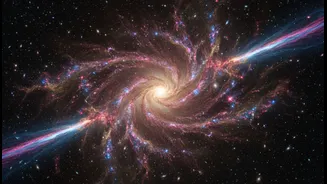
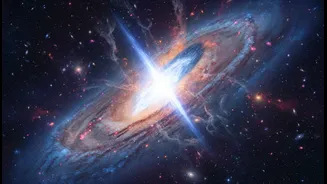
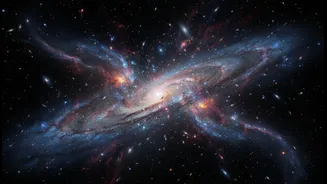
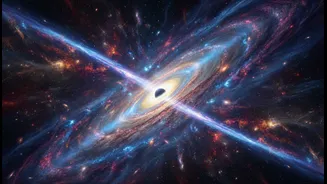
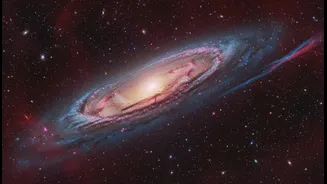
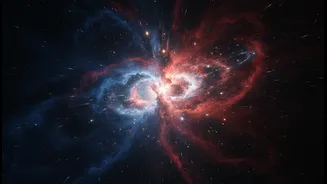
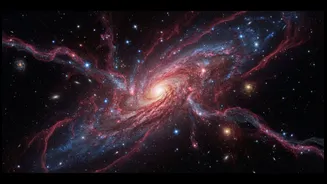
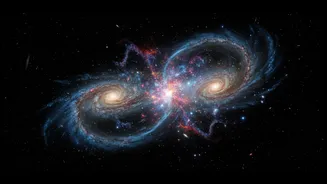
The universe is a dynamic place, far from the serene expanse it might appear to be. Galaxies merge, and within them, giant molecular clouds can crash into one another. These cosmic collisions are not instantaneous, explosive events but rather slow, powerful processes that can unfold over millions of years. When two galaxies interact, gravitational tidal forces can rip streams of gas and dust from them, funnelling this material into compressed regions. On a smaller but equally dramatic scale, two giant molecular clouds within the same galaxy can collide. This process is a key trigger for what astronomers call a “starburst,” a period of exceptionally high star formation. The collision sends powerful shockwaves rippling through the clouds, providing the violent nudge needed to kickstart creation.
The Spark of Creation
The key to turning a quiet nebula into a star-producing engine lies in compression. As the shockwaves from a collision plough through the dark nebula, they act like a cosmic snowplow, sweeping up and squeezing the gas and dust. This compression dramatically increases the density in parts of the cloud. As the gas becomes denser, its own gravity starts to take over. Pockets of the cloud, which were once stable, now begin to collapse under their own weight. This process of shock-induced collapse is considered a primary mechanism for triggering star formation. The once-diffuse cloud breaks up into a network of dense, filamentary structures and clumps, each one a potential birthplace for a future star or even an entire star cluster.
From Compressed Gas to Nuclear Fire
Inside these newly formed dense cores, the collapse continues. As gas and dust fall inward, the core heats up due to friction and increasing pressure, forming a protostar—a baby star. For millions of years, this protostar will continue to gather mass from its surrounding envelope of gas. Eventually, the temperature and pressure at its centre become so immense that a new kind of fire is lit: nuclear fusion. This is the moment a true star is born. Hydrogen atoms begin fusing into helium, releasing an enormous amount of energy that pushes outward, finally halting the gravitational collapse. The new star blazes to life, often as part of a stellar cluster with hundreds of siblings born from the same collisional event.
A Universal Engine for Star Birth
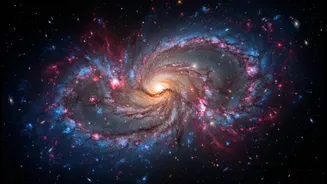
This transformative process isn't a rare or isolated event; it's a fundamental mechanism that drives the evolution of galaxies across the universe. Collisions, whether between entire galaxies or the giant clouds within them, are a primary driver of starbursts, which are responsible for creating a significant portion of all stars. Modern observatories like the James Webb Space Telescope are providing astronomers with unprecedented views of these cosmic events. They can peer through the dust to see stars being born in the aftermath of galactic mergers, confirming that these violent encounters are essential for building new generations of stars and shaping the galaxies we see today. A recent NASA discovery even found a collision of stars within a tiny galaxy that was itself born from the collision of larger galaxies, illustrating the nested nature of these creative processes.