




A Rocket's Unplanned Final Journey
In January 2025, a SpaceX Falcon 9 rocket successfully launched two lunar landers into space. While its first stage returned to Earth for reuse, the rocket's upper stage completed its main task of pushing the payloads toward the Moon and was left to drift
in a long, looping orbit. Typically, such components either burn up in Earth's atmosphere or are pushed into a stable, out-of-the-way orbit. This one, however, didn't follow the script. SpaceX noted that while it performed maneuvers to place the stage in a safe trajectory, a combination of solar activity and gravitational forces from the Earth, Moon, and Sun slowly altered its path. This set the stage for an unexpected and scientifically valuable finale.
From Debris to Discovery
For over a year, the 4-ton, 45-foot-long rocket stage tumbled through space. Its fate was largely unknown until independent astronomers, like Bill Gray of Project Pluto, began tracking the object. Using publicly available data and his own software, Gray and others calculated that the gentle but persistent nudges from gravity had put the booster on a direct collision course with the Moon. NASA's Center for Near Earth Object Studies later confirmed a 100% chance of impact. Suddenly, what was once considered space debris transformed into a free, unplanned impact experiment—a rare opportunity that scientists were eager to seize.
The Science of a High-Speed Crash
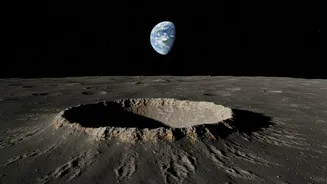
On August 5, 2026, the rocket stage slammed into the lunar surface near the Einstein Crater at a blistering 5,400 miles per hour. While the impact itself wasn't visible from Earth, the scientific payoff was immediate. The goal was never to just watch the crash, but to study its aftermath. The collision kicked up a massive plume of lunar dust and rock, material from beneath the surface that hasn't seen sunlight in potentially billions of years. By studying this ejecta, scientists can learn about the geology and composition of the Moon. Telescopes, including the Very Large Telescope in Chile, were trained on the event, hoping to analyze the chemical makeup of the plume through spectroscopy.
What We're Learning
Early observations were successful. The European Southern Observatory confirmed it detected the chemical fingerprints of sodium and lithium gas in the plume, which was visible for about five to ten minutes after impact. The sodium likely came from the lunar soil itself, while the lithium may have originated from the rocket's batteries, offering data points for both lunar geology and the characteristics of the impactor. Furthermore, NASA's Lunar Reconnaissance Orbiter was tasked with imaging the impact site before and after the crash to analyze the resulting crater, which is estimated to be 60 to 100 feet wide. Analyzing the shape and size of a crater made by an object with a known mass and velocity helps scientists refine their models of impact events, which is crucial for understanding the Moon's history and for planning future missions.
A Precedent for the Future?
This wasn't the first time a human-made object has hit the Moon; NASA intentionally crashed a probe in 2009 to confirm the presence of water ice at the lunar south pole. However, this unplanned event provided a unique, low-cost opportunity to gather similar data. It serves as a valuable case study, demonstrating how even discarded hardware can yield important scientific returns. The event also highlights the growing importance of tracking space debris, not just as a hazard, but as a potential resource. As humanity prepares for a sustained presence on the Moon, understanding the lunar environment—including how to deal with and potentially even utilize our own leftovers—is more critical than ever.