




The Ultimate Hostile Worksite
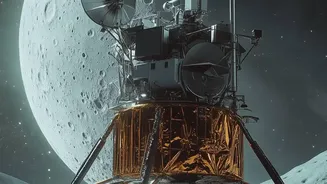
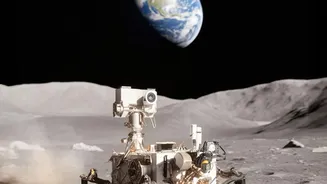
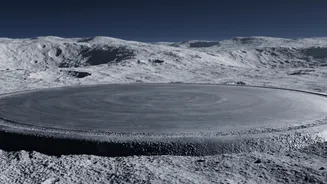
Building on the Moon is one of the greatest engineering challenges humanity has ever faced. The environment is relentlessly hostile, with no atmosphere, wild temperature swings from 127°C to -173°C, and a constant barrage of cosmic radiation. The lunar
surface is covered in regolith, a fine, abrasive dust that is electrostatically charged, clings to everything, and can wear down mechanical parts. Furthermore, the cost of transporting materials from Earth is astronomical, estimated at up to $1 million per kilogram, making it impossible to simply ship bricks and steel for a lunar habitat. These factors make sending human construction crews impractical and dangerous.
Enter the Robotic Workforce
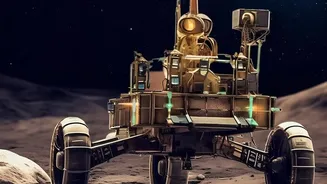
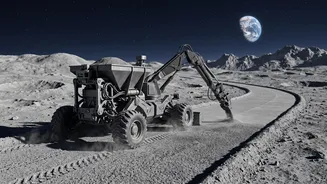
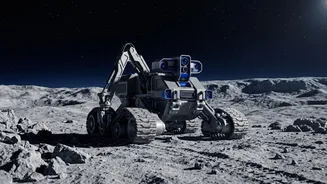
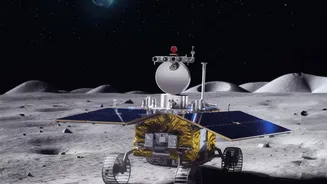
The only viable solution is a robotic workforce that can build the necessary infrastructure before humans arrive for long-duration stays. But these can't be simple remote-controlled machines. The communication delay between Earth and the Moon makes real-time control slow and clumsy. Therefore, the robots must be autonomous, capable of making their own decisions to survey sites, excavate, move materials, and construct structures with minimal human oversight. These machines will be the true pioneers, laying the groundwork for landing pads, habitats, roads, and protective berms.
Learning on Earth to Build on the Moon
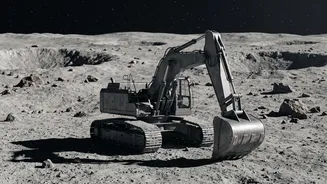
The technology powering this vision is not being developed in a vacuum. Major advancements in autonomous construction are already happening on Earth. Companies are creating self-driving excavators and bulldozers for large-scale mining and construction projects, proving the core concepts of robotic labor. These terrestrial systems provide a crucial foundation. NASA and its commercial partners are now adapting this technology for the unique challenges of the lunar environment. For example, the Cold Operable Lunar Deployable Arm (COLDArm) is engineered to function in the freezing lunar dark without traditional lubricants, which would fail in the vacuum of space.
3D-Printing a Home with Moon Dust
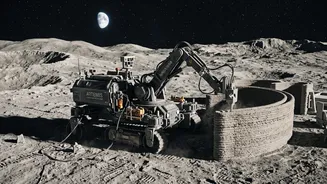
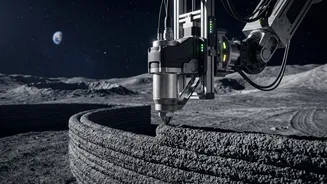
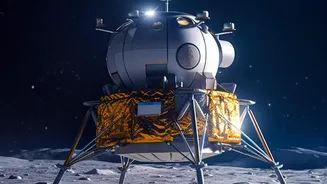
A key strategy for lunar construction is known as In-Situ Resource Utilization (ISRU), which means 'living off the land'. The most promising application of ISRU is using lunar regolith as a building material. Companies like ICON, under contract with NASA, are developing systems for Project Olympus, which aims to 3D-print structures using simulated moon dust. The concept involves robotic printers melting the regolith with lasers or mixing it with a binding agent to create a durable, concrete-like material. This material can then be layered to build habitats, landing pads, and shields that protect against radiation and micrometeorites.
A Coordinated Robotic Team
Building a lunar base is a complex job that no single robot can do alone. Future missions will deploy swarms of coordinated robots, each specializing in a different task. One robot might survey the terrain and identify the best building site, while others excavate and collect regolith. Another group of robots would then transport the material to a large 3D printer, which constructs the primary habitat. Software is being developed to allow these robotic teams to divide tasks and collaborate without waiting for commands from Earth, ensuring the project continues even if one machine breaks down. This level of autonomy is critical for efficiency and success in an environment where help is 239,000 miles away.