





The Kayak Stroke: Rhythmic Endurance
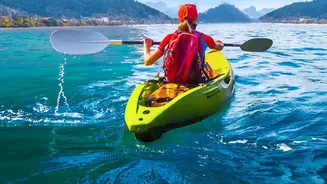
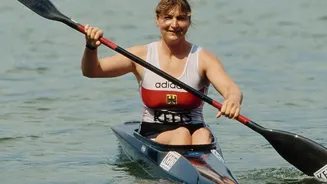
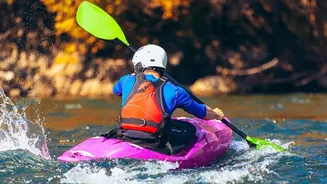
At first glance, kayaking seems like an arm-dominant sport. While your arms are certainly involved, a proper kayaking stroke is a full-body movement powered by your core. The primary motion is rotational; you push with one hand and pull with the other,
engaging your torso to drive the paddle. This creates a rhythmic, repetitive cycle that heavily recruits your back muscles (latissimus dorsi), shoulders, and arms. Think of it as a sustained effort. Over a long paddle, the challenge isn't a single powerful pull, but maintaining that consistent stroke rate for an hour or more. This builds exceptional upper-body and core endurance, allowing you to cover significant distances efficiently. The seated position provides stability, letting you focus entirely on the power and rhythm of your stroke without needing to constantly correct your balance.
The Paddleboard Stroke: A Test of Stability
Stand-up paddleboarding offers a different kind of challenge. While you also use a paddle, the act of standing on an unstable surface changes everything. Your entire body, from your feet to your head, is constantly working to maintain balance. This means your core, leg, and stabilizer muscles are always engaged. The SUP stroke itself is more of a vertical pull. You reach forward, plant the paddle, and pull your body past it. This powerful motion engages the lats, shoulders, and arms, but it is deeply integrated with the core and lower body for stability. Unlike the continuous rotation of kayaking, paddleboarding involves powerful bursts of effort combined with constant, subtle adjustments to stay upright. This makes it a fantastic full-body workout that emphasizes core strength and balance over pure, repetitive upper-body endurance.
A Direct Muscle Comparison
When you break it down by muscle group, the differences become even clearer. Kayaking is an upper-body powerhouse, specifically targeting the back and shoulders for propulsion and the core for rotation. The repetitive push-pull motion ensures your lats, deltoids, biceps, and triceps get a sustained workout. While your legs are used to brace against the kayak for stability, their role is secondary compared to the upper body and torso. Paddleboarding distributes the effort more evenly across the entire body. Balancing requires constant activation of your legs, glutes, and deep core stabilizers. The paddling motion works the upper body, but the force is generated through a full-body connection, from your hands on the paddle down to your feet on the board. For this reason, it is often described as a more comprehensive full-body workout.
Which Is Right For Your Fitness Goals?
The 'better' choice truly depends on what you want to achieve. If your primary goal is to build upper-body endurance and strength through a rhythmic, sustained cardiovascular workout, kayaking is an excellent option. It allows you to settle into a steady effort and is often preferred for longer-distance journeys. It's also generally easier for beginners to master because stability is less of an issue. On the other hand, if you are looking for a total-body fitness challenge that will dramatically improve your balance and core stability, paddleboarding has the edge. The constant need to stabilize your body on the board provides a unique workout that engages muscles you might not typically use. It's an excellent low-impact option that strengthens your entire frame while you paddle.