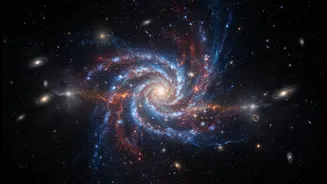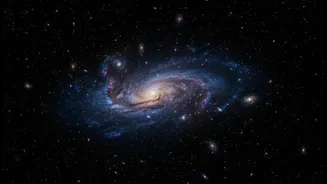






Meet the Sparkler Galaxy
Imagine looking back in time, not by years, but by billions of them. That's what the James Webb Space Telescope (JWST) allows astronomers to do. In one of its first deep-field images, amidst a sea of thousands of galaxies, scientists spotted something
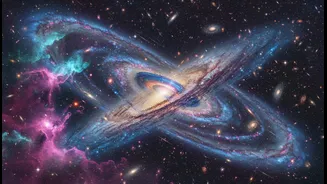
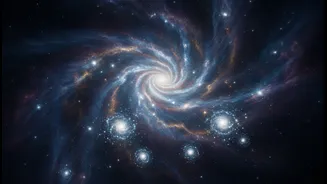
special: a galaxy stretched and magnified by a cosmic phenomenon known as gravitational lensing. This process, where a massive object in the foreground bends light from behind it, gave them an unusually detailed view of a galaxy located some 9 billion light-years away. Researchers nicknamed it the 'Sparkler' because it's surrounded by a swarm of glittering, compact objects. These 'sparkles' are believed to be globular clusters, dense and ancient groupings of stars that offer a pristine window into the universe’s infancy.
Cosmic Chemistry 101: What is Metallicity?
To understand the Sparkler's importance, we first need to talk about cosmic ingredients. In astronomy, 'metals' refer to any element heavier than hydrogen and helium. The early universe was made almost exclusively of these two lightest elements. The first generation of massive stars acted as cosmic forges, fusing hydrogen and helium into heavier elements like carbon, oxygen, and nitrogen. When these stars died in powerful supernova explosions, they scattered these newly-minted metals across space, enriching the gas clouds that would form the next generation of stars. Each subsequent generation of stars contained more of these heavier elements. This gradual process of chemical enrichment is known as increasing 'metallicity,' and it's the reason rocky planets like Earth could eventually form.
Decoding the Sparkler's Light Signature
When astronomers analyzed the light from the Sparkler and its surrounding clusters, they found a surprise. The light signature, or spectrum, revealed the chemical makeup of these ancient objects. According to established theories, a galaxy this old should be relatively poor in metals. However, the analysis suggested that some of the globular clusters around the Sparkler were surprisingly 'metal-rich' for their age. It indicated that several generations of stars had already lived, died, and seeded the region with heavy elements just a few billion years after the Big Bang. This was a puzzle. How did this corner of the cosmos become so chemically mature, so quickly?
A Faster, Messier Early Universe
The findings from the Sparkler Galaxy challenge the traditional, more linear timeline of cosmic evolution. They suggest that the chemical enrichment of the universe wasn't a slow, uniform process. Instead, it was likely faster and more localized, with some regions becoming chemically complex much earlier than previously thought. The Sparkler’s high metallicity implies an incredibly rapid and intense period of star formation and death in its youth, creating a pocket of cosmic richness ahead of schedule. This discovery, alongside other recent JWST findings, is painting a new picture of the early universe as a more dynamic and chaotic place than we ever imagined, where the building blocks for complex structures and even life might have been available sooner than we thought.