


A New Window on the Cosmos
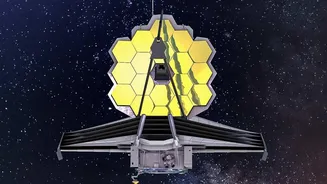
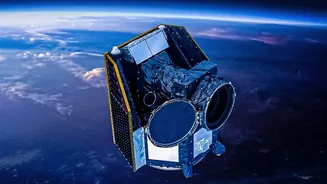
Since its launch, the James Webb Space Telescope (JWST) has been rewriting our understanding of the universe. While the Hubble Space Telescope gave us stunning visible-light images, JWST is designed to see the cosmos in infrared light. This is a crucial
difference. Infrared is the wavelength of heat, and it allows the telescope to peer through cosmic dust clouds that would otherwise obscure our view. More importantly for planet hunters, it is the perfect tool for analysing the chemical makeup of atmospheres on distant worlds. By capturing the faint light of a star after it has passed through a planet’s atmosphere, JWST can detect the chemical fingerprints of different molecules, telling us what an alien sky is made of. This capability has opened up a new frontier in the search for habitable worlds.
Spotlight on a 'Steam World'
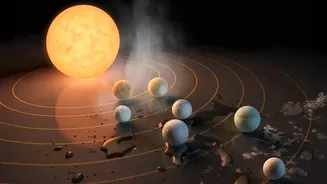
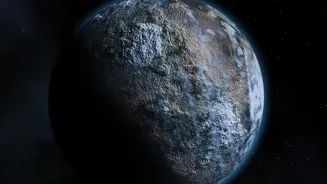
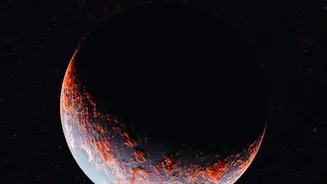
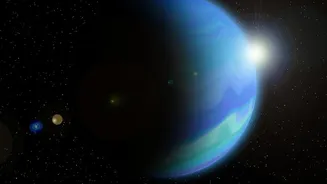
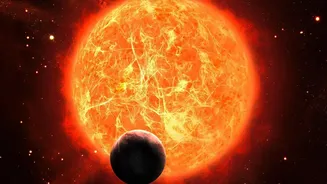
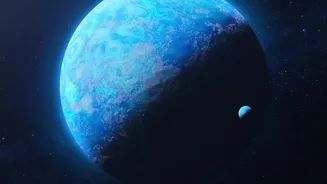
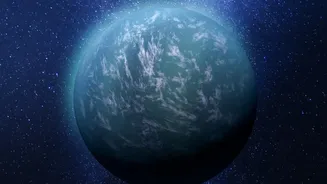
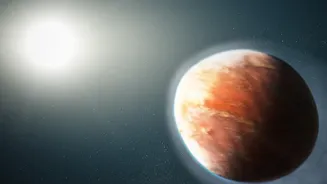
The latest groundbreaking discovery centres on GJ 9827d, a planet located nearly 100 light-years from Earth. Roughly twice the size of our own planet, it orbits its star so closely that its temperature is scorching, comparable to that of Venus. While Hubble had previously found hints of water, JWST's powerful infrared spectrographs have now confirmed that the planet’s atmosphere is thick with water vapour. This isn't a world with gentle oceans and fluffy clouds; scientists are calling it a potential 'steam world,' a planet enshrouded in a hot, dense water-rich atmosphere. The discovery is a landmark moment. While we have found water on massive gas giants before, finding it in such abundance around a smaller, more Earth-sized planet is a huge step forward in understanding the diversity of worlds in our galaxy.
Reading an Alien Barcode
So how exactly does JWST 'see' water from trillions of kilometres away? The technique is called transmission spectroscopy. As an exoplanet passes in front of its host star from our perspective (an event known as a transit), a tiny fraction of the starlight filters through the planet's atmosphere. Molecules in that atmosphere, like water vapour, absorb very specific colours, or wavelengths, of this light. Imagine the starlight as a full rainbow; after passing through the atmosphere, certain colours will be missing, creating a unique 'barcode'. JWST's instruments are exquisitely sensitive to this effect. By analysing which colours are missing from the starlight's barcode, scientists can definitively identify the molecules present, including not just water, but also potentially methane, carbon dioxide, and other gases that are crucial signposts in the search for life.
A Planet's Origin Story
The details on GJ 9827d raise fascinating questions about how such planets form and evolve. One theory is that the planet formed much farther from its star, in a colder region where water ice is plentiful, and then migrated inward over millions of years. As it got closer to the star's intense heat, the ice would have turned to vapour, creating the steamy atmosphere we see today. Another possibility is that the planet is what's left of a 'mini-Neptune'—a gas-rich planet that was stripped of its lighter hydrogen and helium atmosphere by intense stellar radiation, leaving behind the heavier water molecules. Understanding which scenario is correct helps scientists piece together the complex puzzle of planetary formation, not just for this world, but for countless others across the galaxy, including rocky worlds that may be more like our own.
The Quest for Habitable Worlds
To be clear, GJ 9827d is far too hot to be habitable for life as we know it. Its surface is likely a scorching, high-pressure environment. However, the discovery is incredibly exciting because it proves that planets with significant water atmospheres can and do exist. It demonstrates that the raw ingredients for life are not unique to our solar system. Each detection like this is a crucial data point that refines the search. The techniques used here will now be applied to smaller, cooler, rocky planets that orbit within their star's 'habitable zone'—the 'Goldilocks' region where temperatures could allow for liquid water to exist on the surface. This finding isn't about discovering aliens; it is about confirming that one of the most essential prerequisites for life is out there, waiting to be found on other worlds.