

The Sun's Violent Outbursts
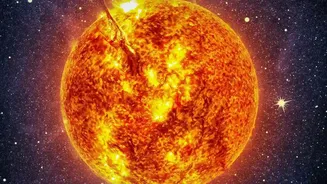
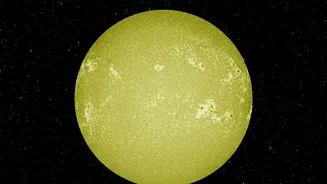
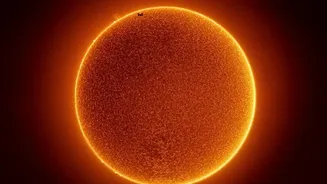
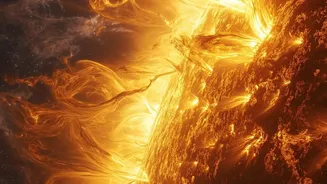
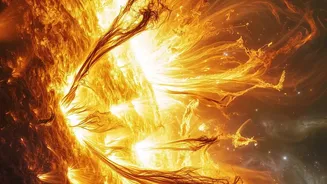
The sun is not a benign, unchanging star. It’s a turbulent sphere of hot, electrically charged gas. Sometimes, twisted magnetic fields on its surface snap and realign, causing a monumental explosion of energy. These events, known as solar flares and Coronal
Mass Ejections (CMEs), hurl billions of tonnes of plasma and magnetic fields into space at incredible speeds. While flares are intense bursts of radiation that reach Earth in about eight minutes, CMEs are vast clouds of charged particles that can take one to four days to arrive. It is the CME that poses the most significant threat to our technological world.
When Space Weather Hits Home
When a powerful CME collides with Earth, it interacts with our planet's natural magnetic shield, the magnetosphere. This collision compresses and distorts the magnetic field, generating what is known as a geomagnetic storm. While this interaction produces beautiful auroras, it also has a more dangerous side effect: it induces powerful, low-frequency electrical currents in the Earth's crust. These are called geomagnetically induced currents, or GICs. These currents seek the path of least resistance, and unfortunately, our man-made infrastructure provides a perfect route.
The Power Grid's Greatest Vulnerability
The most well-documented risk is to our electrical power grids. GICs flow through long transmission lines, which act like giant antennas. The currents then enter large power transformers at substations. These transformers are designed for high-voltage alternating current (AC), but GICs are more like direct current (DC). This quasi-DC influx can saturate the transformer's magnetic core, causing it to overheat dramatically. This can lead to catastrophic failure, permanent damage, and widespread, long-lasting blackouts. Replacing these custom-built transformers can take months or even years, making the power grid exceptionally vulnerable.
Knocking Out Our Eyes in the Sky
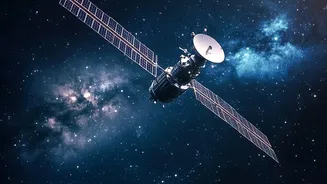
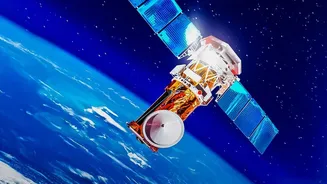
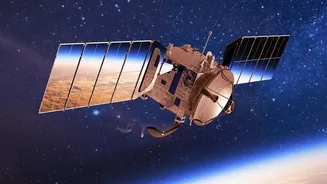
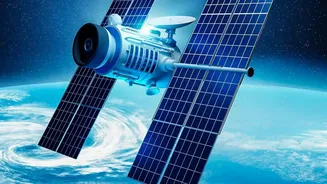
Our reliance on satellites for everything from GPS navigation and communication to weather forecasting makes them another critical point of failure. A geomagnetic storm can affect satellites in two main ways. Firstly, the storm can heat and expand the Earth's upper atmosphere, increasing atmospheric drag on low-orbit satellites and causing their orbits to decay. Secondly, the high-energy particles within the storm can directly damage sensitive electronics on board, leading to malfunctions or complete failure. During the May 2024 geomagnetic storm, for instance, GPS guidance for precision farming equipment was disrupted across several regions.
The Internet's Undersea Achilles' Heel
While we often think of the internet as a 'cloud', over 95% of international data is transmitted through a physical network of submarine fibre-optic cables. The glass fibres themselves are immune to GICs, but the cables are not simply passive conduits. To maintain signal strength over thousands of kilometres, electronic repeaters are placed every 50 to 150 kilometres along the cable. These repeaters are powered by an electrical conductor that runs alongside the fibres. This long conductor is highly susceptible to geomagnetically induced currents. A severe storm could fry these repeaters, rendering entire trans-continental cables useless and potentially creating a global internet outage that could last for weeks or months while complex undersea repairs are made.
Lessons from History and Future Risks
The most powerful geomagnetic storm on record, the 1859 Carrington Event, caused telegraph systems worldwide to fail, throwing sparks and even setting paper on fire. Some operators could even send messages with their batteries disconnected, powered only by the storm's induced current. A storm of that magnitude today would be catastrophic. While smaller storms, like the one that caused a major blackout in Quebec in 1989, provide a glimpse of the risk, our global dependence on digital infrastructure has grown exponentially since then. We are now more vulnerable than ever before.