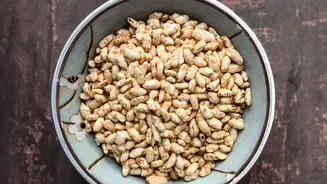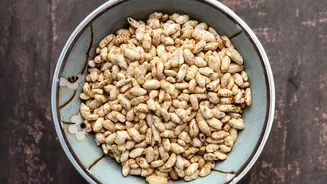







In the snack aisle, the battle for the 'healthiest puff' is on. Quinoa puffs and puffed rice are two popular light, crunchy options. While both seem like virtuous choices, a deeper dive into their nutritional labels reveals significant differences.
The Fibre Face-Off
The
headline feature is fibre, so let’s start there. Dietary fibre is crucial for digestive health, promoting satiety and helping to regulate blood sugar. When it comes to this vital nutrient, quinoa puffs have a clear advantage. A typical serving of quinoa puffs contains significantly more fibre than the same amount of puffed rice. For instance, some data shows that quinoa can contain around 2.5 grams of fibre per serving, whereas puffed rice often has less than half a gram. While plain puffed rice is often praised for being easy to digest, its low fibre content means it's less effective at keeping you feeling full. For a snack that truly tides you over until your next meal, the higher fibre in quinoa puffs makes it the superior choice.
The Protein Punch
Protein is another area where the differences are stark. Quinoa is famously a complete protein, meaning it contains all nine essential amino acids, which is rare for a plant-based food. This superior protein profile is retained when it's puffed. A 100-gram serving of puffed quinoa can contain around 13 to 14 grams of protein. In contrast, puffed rice offers much less, typically around 7 grams of protein per 100 grams, and it is not a complete protein. In a standard snack-sized serving, this difference is very noticeable—quinoa puffs might provide 4-6 grams of protein, while puffed rice may only offer 1-2 grams. This makes quinoa puffs a much more effective snack for muscle repair, satiety, and overall nutritional balance.
Calories and Carbohydrates
Here, the roles are reversed. Puffed rice is the undisputed winner if your primary goal is low-calorie volume. A cup of plain puffed rice can contain as few as 56 calories, making it an extremely light snack. Puffed quinoa is more calorie-dense, with a similar volume containing closer to 110-120 calories. Most of the calories in puffed rice come from carbohydrates, and it has a high glycemic index (around 82), meaning it can cause a rapid spike in blood sugar when eaten alone. Quinoa has a more moderate glycemic index (around 53) and its carbohydrates are balanced with more protein and fibre, leading to a slower energy release.
Micronutrient Matchup
Beyond the big three (fibre, protein, carbs), micronutrients are what truly separate a nutrient-dense food from empty calories. Puffed quinoa is a good source of minerals like iron, magnesium, and zinc. These nutrients are retained reasonably well during the puffing process and contribute to everything from energy production to immune support. Puffed rice, on the other hand, is not particularly nutrient-dense. While some commercial brands are fortified with iron and B vitamins, the base product offers minimal micronutrients. For those looking to get more nutritional value from their snacks, quinoa puffs provide a much broader spectrum of essential vitamins and minerals.
The Verdict: Which Puff Is for You?
So, which one should you choose? It depends entirely on your goals. For a nutrient-dense, high-fibre, and high-protein snack that will keep you full and support overall health, quinoa puffs are the clear winner on almost every metric. They are particularly good for active individuals, those focused on balanced nutrition, or anyone looking for a more substantial snack.Puffed rice shines in a different context. If you are looking for a very low-calorie, low-fat, and easy-to-digest base for a larger snack (like bhel puri), or you need a quick, light pre-workout carb source, it can be a suitable choice. The key is to pair it with other ingredients like vegetables, nuts, or legumes to add the fibre and protein it lacks on its own.