




An Icy Solution to a Warming World
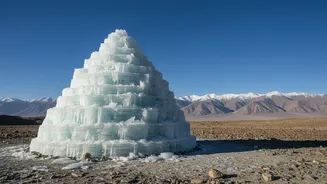
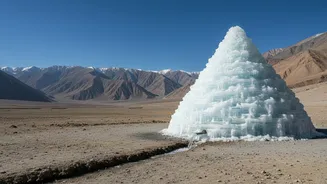
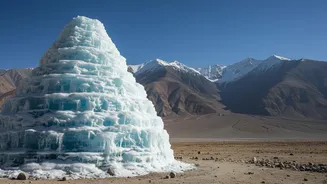
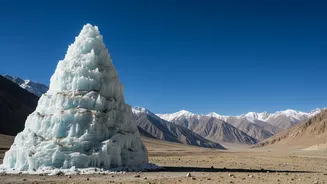
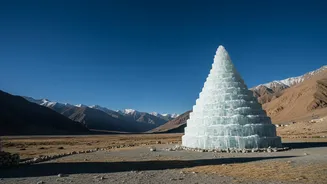
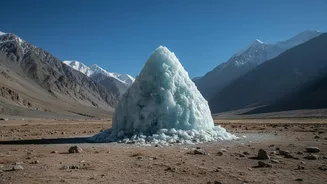
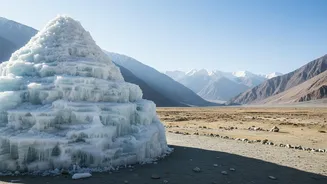
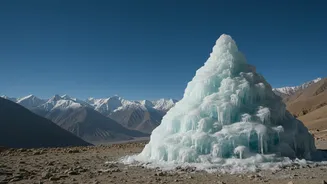
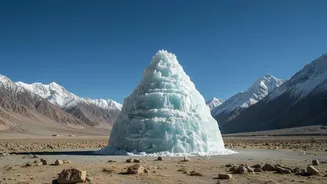
Imagine a giant cone of ice, shimmering in the mountain sun, standing tall in a barren valley. This is an ice stupa, a man-made glacier designed to combat a critical problem. Ladakh, a cold desert, receives very little rainfall and has historically relied
on melting snow and glaciers for its water needs. However, rising global temperatures are causing glaciers to recede and melt patterns to shift. Water often becomes scarce in the crucial spring planting season of April and May, as natural meltwater arrives too late. Ice stupas solve this timing mismatch by capturing water from streams during the harsh winter months—water that would otherwise flow away unused—and storing it as towering cones of ice.
The Mind Behind the Mountain of Ice
The ice stupa is the brainchild of Ladakhi engineer and innovator Sonam Wangchuk, who sought a practical solution to the water woes of his home region. His inspiration came from a simple observation: ice that remained frozen under a bridge, shielded from direct sun, well into the spring. Wangchuk realised that the shape of the ice mattered. He hypothesised that a cone, which presents a minimal surface area to the sun for its volume, would melt much slower than a flat sheet of ice. In 2013, he and his team at the Students' Educational and Cultural Movement of Ladakh (SECMOL) built their first prototype, a 6-metre-high structure that successfully stored 150,000 litres of water and lasted until the summer, proving the concept worked.
How to Build a Glacier
The genius of the ice stupa lies in its simplicity, harnessing basic physics and the local environment. The process requires no pumps or external power. A pipeline is laid from an upstream water source at a higher altitude, channelling water down to the village. Due to gravity and the elevation difference, the water pressure is enough to push it up a vertical pipe, from which it sprays out like a fountain. In the sub-zero winter temperatures of Ladakh, this fine spray of water freezes as it falls, gradually forming a massive, cone-shaped ice mountain around the pipe structure. These conical glaciers, named for their resemblance to traditional Buddhist stupas, can grow to be over 100 feet tall and store millions of litres of water.
From Ice to Irrigation
The true magic of the ice stupa happens in the spring. As the days grow warmer and longer, the cone begins to melt—slowly and steadily. This meltwater provides a consistent supply of water exactly when farmers need it most for sowing their crops, such as barley, wheat, and vegetables. Before the advent of these artificial glaciers, many farmers faced dry fields and the risk of crop failure. Now, villages with ice stupas have an assured source of early-season irrigation, turning previously barren land green. In one project inauguration, villagers planted over 5,000 tree saplings using water from an ice stupa, transforming a patch of desert. The impact is direct and life-changing, boosting agricultural output and food security.
A Symbol of Hope and Resilience
The ice stupa project has become more than just a water conservation technique; it is a powerful symbol of community-led climate adaptation. The initiative, often driven by villagers themselves through competitions, has fostered a sense of ownership and collective action. Beyond agriculture, the project has spurred eco-tourism, with some villages building cafes at the base of the stupas and hosting ice-climbing festivals, creating new economic opportunities for local youth. The success of these structures in Ladakh has attracted global attention, with similar projects being trialled in other mountain regions, including the Swiss Alps. It's a testament to how local, low-cost innovations can offer tangible solutions to the global challenges of climate change.