


The Universe’s Ultimate Speed Limit
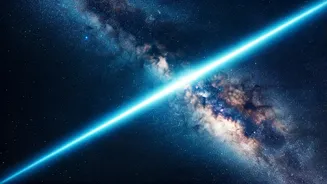
Everything we see is thanks to light. But unlike a thought or an idea, light doesn’t travel instantaneously. It moves incredibly fast, but it still has a speed limit. In the vast, empty vacuum of space, light travels at approximately 300,000 kilometres
per second. That’s fast enough to circle the Earth more than seven times in a single second. While that sounds immediate, the universe is so incomprehensibly large that even at this breakneck speed, light takes time—a lot of time—to get from one place to another. Our own Sun, the closest star to us, is about 150 million kilometres away. The light you see from it right now actually left the Sun about 8 minutes and 20 seconds ago. If the Sun were to suddenly vanish, we wouldn’t know about it for over eight minutes. This delay is the fundamental key to understanding why looking at the night sky is the same as looking back in time.
Thinking in Light-Years
Because the distances in space are so enormous, using kilometres becomes impractical very quickly. Instead, astronomers use a unit called a 'light-year'. It sounds like a measure of time, but it’s actually a measure of distance. One light-year is the distance that light travels in one year—a staggering 9.46 trillion kilometres. So, when we say a star is 10 light-years away, it means the light we are seeing from it today began its journey 10 years ago. The star itself could have changed in those 10 years, but we are seeing its decade-old self. The closest star system to us, Alpha Centauri, is about 4.3 light-years away. The light we see from it tonight left around the time the last FIFA World Cup was being played. This simple fact transforms stargazing from a simple act of observation into an act of cosmic archaeology.
Postcards from the Mughal Era
The headline’s claim of “centuries” is not an exaggeration. Take Polaris, the North Star, a celestial landmark for travellers for generations. Polaris is roughly 433 light-years away. The light we see when we locate it in our night sky left the star around the year 1591. At that time, Akbar was ruling the Mughal Empire, and William Shakespeare was just beginning to write his famous plays in England. We are seeing a star as it was during a completely different era of human history. Another famous example is Betelgeuse, the bright red star in the Orion constellation. It sits about 640 light-years from Earth. The light reaching us now started its journey around the year 1384, long before the first European ships landed in India. Betelgeuse is a red supergiant nearing the end of its life, and scientists believe it could go supernova at any moment. The cosmic twist? It might have already exploded 300 years ago, and we simply haven’t received the news yet. We are watching a star on death row, completely unaware if the sentence has already been carried out.
Beyond Stars to Ancient Galaxies
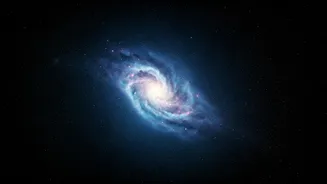
The time-travel effect becomes even more dramatic when we look beyond the stars in our own galaxy. The Andromeda Galaxy is our closest major galactic neighbour. It’s visible to the naked eye as a faint, fuzzy smudge on a very dark night. That faint smudge is an entire galaxy containing a trillion stars, and it is 2.5 million light-years away. The light hitting your retina from Andromeda tonight left that galaxy when our earliest human ancestors, of the genus *Homo*, were just beginning to walk the Earth. You are not just looking at another galaxy; you are looking at light that is older than our entire species. Telescopes like the Hubble and the James Webb Space Telescope are designed to be powerful time machines. They peer even deeper into space, capturing light from galaxies that are over 13 billion light-years away. They see the universe not as it is today, but as it was in its infancy, just a few hundred million years after the Big Bang.