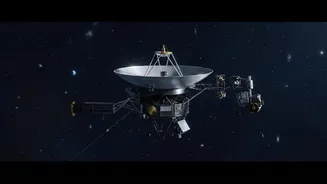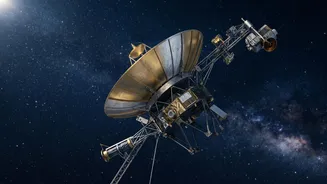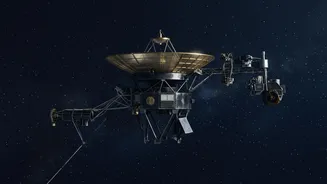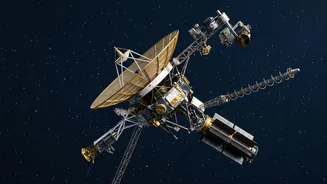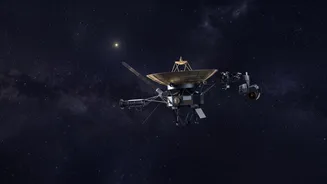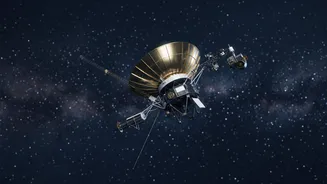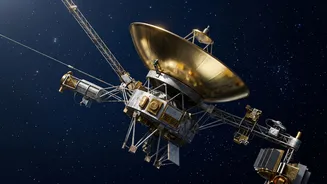


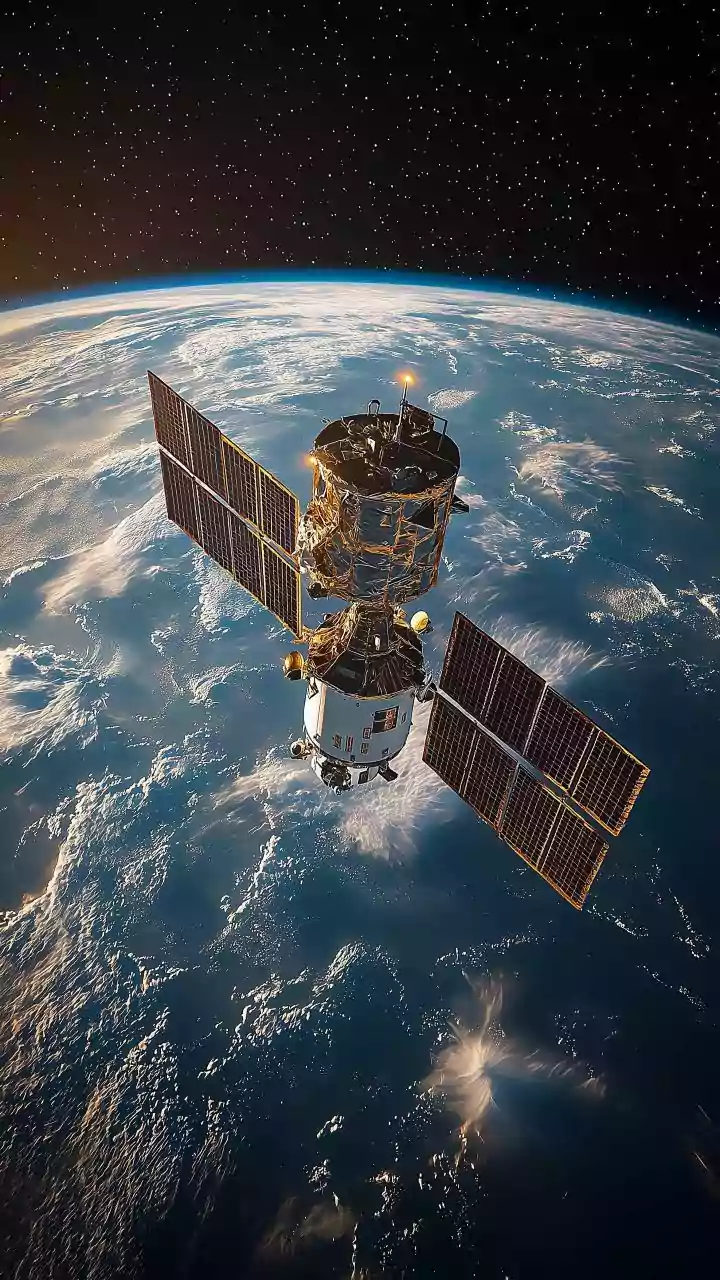
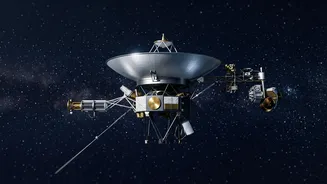
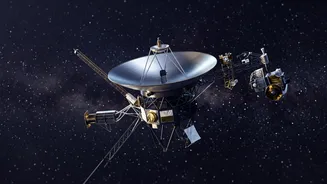
After nearly 50 years pushing the boundaries of space, humanity’s farthest probe, Voyager 1, gave its creators a scare by falling silent. Now, contact is restored, but the incident highlights the incredible challenge of managing an aging asset.
A Sudden Silence from the Void
In mid-October
2026, during two scheduled check-ins, NASA's Deep Space Network received nothing but static from Voyager 1. For 48 tense hours, the line to our most distant emissary, now billions of kilometres away, was dead. The silence was particularly unnerving, coming just weeks after engineers had successfully performed a delicate power-saving manoeuvre nicknamed the 'Big Bang'. Just as mission control was preparing to send troubleshooting commands across the solar system, a signal reappeared on October 20. Voyager 1 had fixed itself. Initial analysis shows the spacecraft's fault protection systems likely triggered, detecting an issue with its active thrusters and automatically switching to a backup set, a feature that put the probe into a safe but non-communicative state. While relieved, engineers are still investigating the root cause, acknowledging that at this stage of the mission, they must expect the unexpected.
The Constant Battle Against Fading Power
The brief communication loss underscores the central challenge facing the Voyager mission: power management. Launched in 1977, both Voyager probes are powered by radioisotope thermoelectric generators, which convert heat from decaying plutonium into electricity. This power source has been incredibly reliable, but its output naturally dwindles, losing about four watts of power each year. With razor-thin margins, NASA engineers have become masters of long-distance energy conservation. In recent years, this has meant making tough decisions to turn off science instruments to keep the spacecraft alive. The recent 'Big Bang' procedure in September was a creative solution to delay the next instrument shutdown. Engineers simultaneously swapped three more power-hungry devices for lower-power alternatives, a move that will allow Voyager 1's remaining science instruments to operate longer than previously anticipated. Without it, another instrument might have been switched off by summer 2027.
An Unprecedented Long-Distance Repair
The October glitch wasn't the first time Voyager 1 has given its team a scare. In late 2023, the probe began sending back streams of gibberish instead of usable data. The problem was traced to a single corrupted memory chip in the Flight Data Subsystem (FDS), the computer that packages science and engineering data for transmission to Earth. Over several months, engineers devised an ingenious fix. Unable to repair the chip, they sliced up the affected code and carefully stored the pieces in different locations in the FDS memory, a bit like finding unused corners on a bookshelf to store parts of a book whose main shelf broke. The delicate software patch was sent across 25 billion kilometres, and by June 2024, all four of Voyager 1's active science instruments were sending back usable data again.
What Voyager Tells Us and Where It's Going
Even with a skeleton crew of active instruments, Voyager 1 continues to do groundbreaking science. It, along with its twin, Voyager 2, are the only spacecraft to ever directly sample interstellar space—the region outside the protective bubble of particles and magnetic fields generated by our Sun. Its active instruments still measure cosmic rays, magnetic fields, and plasma waves, giving us priceless data on the environment between the stars. The mission is also on the cusp of a symbolic milestone. On November 18, 2026, the spacecraft will be one light-day from Earth, meaning it will take a full 24 hours for its radio signal to reach us. It continues its journey through the cosmos at over 61,000 kilometres per hour, currently heading in the general direction of a star named Gliese 445, which it is expected to pass in about 40,000 years.