

Saturn Takes Centre Stage
The undisputed star of the late August sky is the planet Saturn. The magnificent ringed planet is currently making its way towards opposition, the point in its orbit where Earth passes directly between it and the Sun. While the exact opposition is on October
4, the planet is already exceptionally bright and well-placed for viewing. Look for a steady, yellowish light rising in the eastern sky as evening sets in. It will be visible all night, trekking across the sky in the constellation Cetus. This year offers a unique view; Saturn’s rings are tilted at a narrow angle of just over seven degrees from our perspective, making them appear like a thin, elegant line through a telescope. Even a basic pair of binoculars can stabilize its light, and a small telescope will reveal the famous rings, a sight that never fails to inspire awe.
Catch the Red Planet Before Dawn
If you're an early riser, another planet awaits your attention. Mars, the Red Planet, is visible in the pre-dawn sky. While not as brilliantly positioned as Saturn, it can be spotted as a distinct, reddish point of light. The alignment of several planets that occurred mid-month has since dispersed, but Mars remains a relatively easy naked-eye target for those willing to wake up before the sun. Its visibility high in the sky before dawn makes it easier to spot compared to other planets like Mercury and Jupiter, which are currently very low on the horizon and lost in the morning twilight. Look towards the east in the hour before sunrise for your best chance to see it.
Navigate by the Summer Triangle
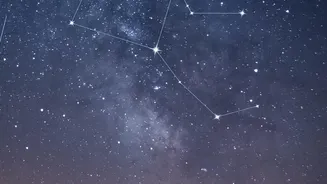
For those looking to learn the constellations, there is no better guidepost in the August sky than the Summer Triangle. This is not a constellation itself, but a prominent asterism formed by three of the brightest stars in the sky: Vega (in the constellation Lyra), Deneb (in Cygnus, the Swan), and Altair (in Aquila, the Eagle). Look almost directly overhead after dark to spot these three brilliant stars forming a large triangle. They are so bright that they can often be seen even from light-polluted urban areas. The Summer Triangle serves as a fantastic celestial map. The band of the Milky Way runs right through it, with the constellation Cygnus sitting in the heart of the star-filled river.
Chasing the Heart of the Milky Way
Speaking of the Milky Way, late summer nights provide a window to view its brightest and most dramatic section: the galactic core. To find it, look towards the southern horizon for the fishhook shape of the constellation Scorpius and the nearby teapot-shaped Sagittarius. The centre of our galaxy lies in the direction of Sagittarius, appearing as a dense, glowing cloud of stars and dust under dark skies. However, there is a significant challenge for most of India: the monsoon. Cloud cover can obscure this view for nights on end. Your best opportunity will be to seize any clear, moonless night and look south. For those in rain-shadow regions, the view can be spectacular.
Tips for a Successful Stargazing Night
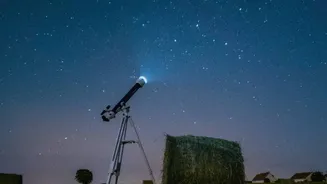
Whether you are on a city terrace or in a remote village, a few tips can enhance your experience. First, be patient. It takes about 20 minutes for your eyes to fully adapt to the darkness and reveal fainter stars. Avoid looking at your phone screen, as its bright light will ruin your night vision. If you need a guide, use a stargazing app in its red-light mode. For city dwellers, finding a park or an open ground away from direct streetlights can make a surprising difference. For those dealing with monsoon weather, it's a game of patience. Keep an eye on weather forecasts and be ready to head out during any break in the clouds.
Where to Find India's Darkest Skies
If you're truly committed to seeing the cosmos in its full glory, escaping city lights is a must. India is home to several locations renowned for their pristine night skies, many of which are conveniently located in areas less affected by the August monsoon. Hanle in Ladakh is India's first official Dark Sky Reserve, offering unparalleled clarity at high altitude. Similarly, the Spiti Valley in Himachal Pradesh provides clear, dry skies perfect for stargazing. Further south and west, the vast, unobstructed horizons of the Rann of Kutch in Gujarat and the desert camps around Jaisalmer in Rajasthan also offer magnificent, dark canvases for the stars to shine.