



The Case of the Disappearing Planet
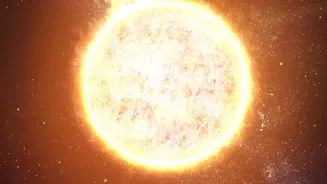
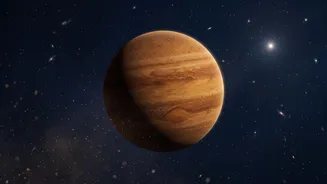
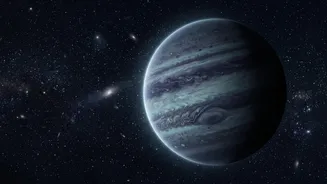
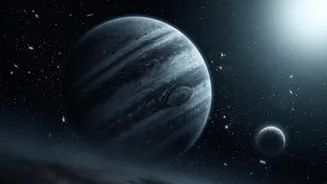
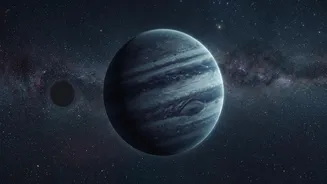
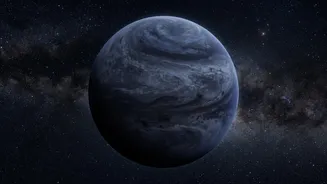
About 1,000 light-years from Earth, a planet known as TOI-2535 b has been playing a cosmic game of peekaboo. This world is what astronomers call a 'hot Jupiter'—a gas giant similar in size to our own Jupiter, but orbiting perilously close to its star.
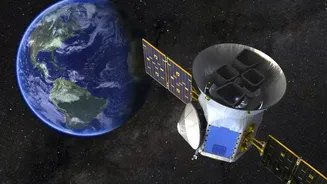
It completes a full lap in just over eight days, a blistering pace compared to Mercury's 88-day year. Astronomers discovered it using NASA's Transiting Exoplanet Survey Satellite (TESS), which detects planets by measuring the slight dimming of a star's light as a planet passes in front of it. For seven years, from 2019, TESS watched TOI-2535 b reliably cross its star. But then, the signals grew fainter, the timing became erratic, and in early 2026, the planet seemingly disappeared altogether. It was the first time astronomers had ever witnessed a known transiting planet vanish while they were watching.
A Cosmic Wobble
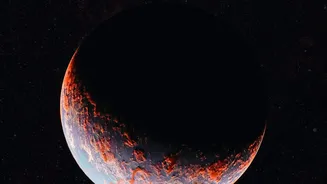
So, where did it go? Planets don't just evaporate. The answer, researchers believe, lies in its bizarre orbit. Before it vanished, the planet’s transits became highly irregular, sometimes arriving up to six hours early or late—a huge deviation. This erratic timing was a major clue that something else was gravitationally tugging on it. The leading theory, published in The Astrophysical Journal Letters, is that a second, as-yet-unseen planet is locked in a gravitational dance with TOI-2535 b. The gravitational pull between the two worlds is causing both of their orbits to precess, or wobble, much like a spinning top. This wobble is slowly tilting TOI-2535 b's orbital plane. From our perspective on Earth, that tilt eventually shifted the planet's path so that it no longer crosses in front of its star. It's still there, just hidden from our specific line of sight.
Hunting for a Ghostly Giant
The existence of this hidden companion, possibly a giant planet with a mass similar to Saturn's or greater, is inferred entirely from its gravitational effects. Astronomers can't see it, likely because its own orbit is also tilted and doesn't currently transit the star from our viewpoint. This dynamic duo offers fascinating clues into how planetary systems form. Hot Jupiters are a puzzle themselves; they are thought to form far from their stars and migrate inward. A violent event, like a near-collision, could fling a planet into a close orbit, but that wouldn't likely leave two giant planets so close together. The presence of a neighbor suggests a gentler migration, where both planets slowly spiraled inward together. This makes the TOI-2535 system a rare and valuable laboratory for understanding planetary evolution.
What Happens Next?
The cosmic game of hide-and-seek is far from over. Based on their models, the UCLA-led team of researchers predicts that the orbital wobble will continue. They calculate that TOI-2535 b will remain hidden from our view for another 30 to 50 years before its orbit tilts back into a transiting alignment. In a fortunate twist, however, the unseen culprit might reveal itself much sooner. The same wobble affecting TOI-2535 b is also acting on the hidden planet, and it's possible that its orbit could tilt into our line of sight in the coming decades, allowing TESS or other telescopes to finally spot it directly. This ongoing mystery highlights that our universe is not always the clockwork mechanism we might imagine; instead, it is a dynamic and often unpredictable place, full of gravitational tugs-of-war that can make entire worlds disappear and reappear over time.