





A Landmark Investment in Physical AI
The $150 million fundraise is one of the largest in recent memory for a 'physical AI' company, placing Eka Robotics at a reported valuation of $1.45 billion. The round saw participation from a host of prominent venture firms, including previous backers
Obvious Ventures and E14 Fund, as well as Samsung Next and several strategic corporate investors. This influx of capital signals a major vote of confidence not just in Eka, but in the belief that the next frontier of artificial intelligence lies in giving it a physical body. The funds are earmarked to help the company scale its core technology, expand its capabilities to handle more complex tasks, and accelerate deployments with its first customers.
The Dexterity Dilemma
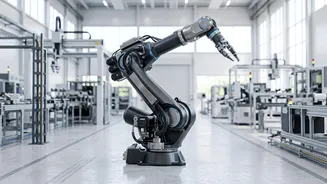
For decades, the holy grail of robotics has been dexterity. While industrial robots are excellent at performing highly repetitive tasks in structured environments—like welding a car door that is always in the exact same spot—they fail spectacularly when faced with variability. Think about the simple act of picking a strawberry from a punnet, grasping a key, or plugging in a cable. These tasks are trivial for humans, who instinctively adjust grip, pressure, and angle based on feel. For a robot, this is a monumental challenge. Most robots rely on vision alone, which can tell them where an object is, but not how to properly hold it. This 'generality-performance gap' has kept robots out of countless industries that require the manipulation of varied and delicate objects.
Eka's Vision-Force-Action Model
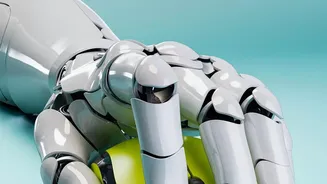
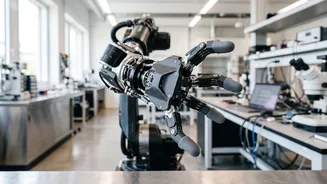
Eka Robotics believes the solution is not just better vision, but adding the sense of touch. The company's core innovation is its 'Vision-Force-Action' (VFA) model. Instead of just seeing an object, Eka's robots combine camera input with feedback from force sensors built into their custom grippers. This allows the robot to 'feel' an object, detecting if a grip is slipping or if it's holding something fragile too tightly, and then correct its actions in real-time. Crucially, Eka bypasses the common method of teaching robots by mimicking human demonstrations. Instead, it trains its AI models through trial and error in a physics simulator. Using reinforcement learning, it can generate thousands of hours of experience in minutes, teaching the robot the underlying physics of manipulation rather than just how to copy a specific movement.
From Lab to Logistics and Beyond
The real-world implications of this technology are vast. Eka reports its robots can already pick up a wide variety of unfamiliar objects at a rate of 1,500 per hour, more than double the average human's speed of around 600 picks per hour. The same system is shown to be capable of dexterous tasks like screwing in a lightbulb or inserting wires, demonstrating a versatility far beyond typical warehouse robots. The most immediate applications are in logistics and manufacturing, where robots could handle tasks like packing delicate produce, assembling complex electronics like GPU server racks, or sorting unpredictable items in an e-commerce warehouse. By creating robots that can adapt to existing human-centric workflows, Eka aims to automate the countless physical jobs that have so far been impossible to automate.
A New Era of Automation
Founded by MIT professor Pulkit Agrawal and former Google DeepMind researcher Tuomas Haarnoja, Eka's team is stacked with talent from the world's top robotics and AI institutions. The company argues that to be truly useful, a general-purpose robot needs to deliver both generality and high performance—a combination that has been elusive until now. This $150 million investment is a significant bet that Eka's physics-based approach, combining sight and touch, is the key to unlocking that potential. If successful, it won't just create a valuable company; it could fundamentally reshape the global economy by bringing intelligent, dexterous automation into nearly every industry that relies on physical work.