

An Ocean World in the Outer Solar System
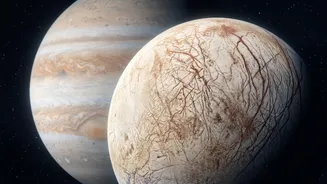
Europa, slightly smaller than Earth's moon, is one of the most compelling destinations in our solar system. For decades, scientists have gathered tantalizing evidence that a vast, saltwater ocean is churning below its icy shell, which is estimated to
be 15 to 25 kilometers thick. This evidence comes from multiple sources. The Galileo spacecraft in the 1990s detected a disruption in Jupiter's magnetic field around Europa, strongly suggesting the presence of a global, electrically conductive fluid—like a salty ocean. Furthermore, the moon's chaotic surface, covered in cracks and shifting terrain, hints at a mobile layer of liquid or warm ice beneath. This internal ocean is kept from freezing solid by tidal heating, a process where gravitational tugging from Jupiter generates internal friction and warmth.
Meet the Robotic Detective: Europa Clipper
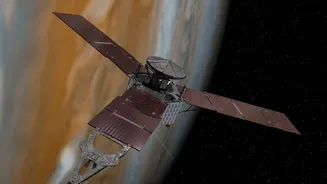
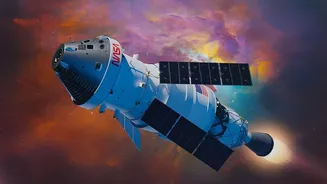
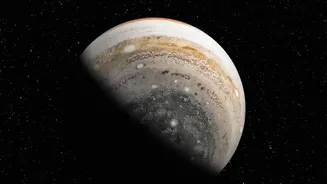
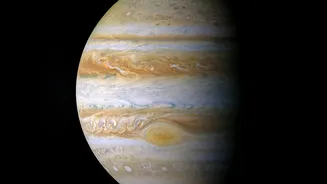
To investigate these mysteries, NASA launched the Europa Clipper spacecraft on October 14, 2024. It's the largest interplanetary spacecraft the agency has ever built, spanning the length of a basketball court with its solar arrays deployed. Clipper is currently on a 2.9-billion-kilometer journey to the Jupiter system, scheduled to arrive in April 2030. To get there, it’s using gravity assists—a slingshot maneuver past Mars in March 2025 and a final one past Earth in December 2026. Because of the intense radiation around Jupiter, Clipper won't orbit Europa directly. Instead, it will enter a long, looping orbit around Jupiter and perform nearly 50 close flybys of the moon, some as low as 25 kilometers above the surface.
A Toolkit for Unlocking Secrets
Europa Clipper is equipped with a powerful suite of nine scientific instruments designed to work in concert. Its main goal is to determine if Europa has the necessary conditions for life. The Radar for Europa Assessment and Sounding (REASON) instrument will peer through the ice shell to confirm the ocean's existence and measure the ice's thickness. A magnetometer will measure the strength and direction of the moon's magnetic field to gauge the ocean's depth and salinity. Spectrometers will analyze the chemical composition of the icy surface and the tenuous atmosphere, looking for salts and organic molecules. Cameras will capture high-resolution images to study Europa's geology and scout for active areas, including potential water plumes erupting into space.
The Search for Habitability, Not Life
It's a crucial distinction: Europa Clipper is not designed to find life itself, but to determine if the moon is habitable. Life as we know it requires three key ingredients: liquid water, essential chemical elements, and a source of energy. Europa appears to have all three. The mission will confirm the water, map the chemistry of the surface, and look for clues about energy sources, such as heat from the seafloor. Some recent research from early 2026 suggested that Europa's seafloor might be geologically quiet, which could reduce the chances of life-sustaining hydrothermal vents. However, Clipper's detailed measurements will provide the data needed to truly assess these models. By flying through any potential plumes of water vapor, the spacecraft could even directly sample material from the subsurface ocean.
What's Next on This Epic Journey?
As of late September 2026, Europa Clipper is continuing its long cruise through the inner solar system, now heading back toward our home planet. Its next major milestone is the Earth gravity-assist scheduled for December 2026. This flyby will provide the final burst of speed needed to reach Jupiter's orbit. After arriving in April 2030, the spacecraft will begin its four-year science phase, conducting flyby after flyby. Each pass will reveal a new piece of the puzzle, building the most detailed portrait of an ocean world other than our own that humanity has ever seen. The data it collects will fundamentally shape our understanding of where life might exist beyond Earth.