






The Universe’s Standard Story
For decades, scientists have had a remarkably successful theory for how the universe evolved. It’s called the Lambda-Cold Dark Matter (ΛCDM) model. In simple terms, it tells a story of gradual, hierarchical growth. After the Big Bang, small clumps of mysterious,
invisible dark matter began to pull in ordinary gas. These small clumps formed the first stars and tiny galaxies. Over billions of years, these small structures merged and grew into the giant galaxies and massive galaxy clusters we see today. It’s a “bottom-up” process, like small villages slowly growing and merging to become sprawling megacities. This model has been brilliant at explaining a wide range of cosmic observations, from the faint afterglow of the Big Bang to the large-scale distribution of galaxies.
A Cosmic Wrench in the Works
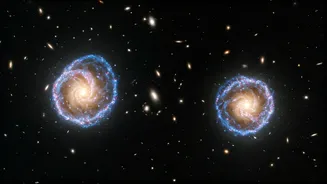
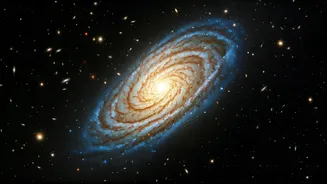
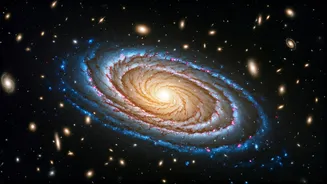
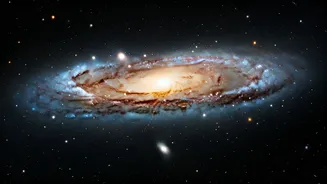
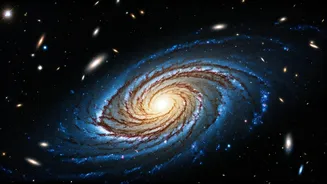
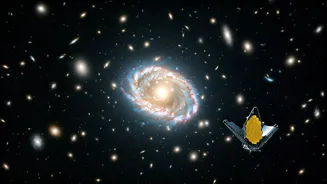
The James Webb Space Telescope was built to peer deep into cosmic history, to see the universe's first, faintest galaxies. And it has delivered spectacularly. But it's also found things that weren't supposed to be there. In the cosmic dawn, just a few hundred million years after the Big Bang, JWST is spotting galaxy clusters—vast collections of galaxies bound by gravity—that are far more massive and mature than expected. Objects like the protocluster JADES-ID1, seen as it was about a billion years after the Big Bang, are showing up a billion or two years earlier than most models predicted they could form. These aren't the tiny, baby galaxies cosmologists expected to see; some appear as mature as our own Milky Way, but in a universe that was only 3% of its current age.
Too Big, Too Soon
The existence of these early giants presents a major headache for the standard story. According to the ΛCDM model, there simply shouldn't have been enough time for gravity to assemble such massive structures. The process of small galaxies merging is slow. Finding a fully-formed city where you expect to see a small settlement forces you to question your understanding of urban development. Similarly, finding these massive "protoclusters" challenges our understanding of cosmic structure formation. Some of these objects, informally dubbed "universe breakers" by some scientists, are so massive they appear to be in tension with 99% of cosmological models. It suggests that galaxy formation in the early universe was happening much, much faster than we thought.
Rethink or Refine?
This is where the debate—the new “talking point”—heats up. Are these observations breaking our fundamental model of the universe, or do they just require some adjustments? The scientific community is buzzing with possibilities. One camp argues that our theories of galaxy formation itself are what need refining. Perhaps stars formed more efficiently in the early universe, or supermassive black holes at the centers of these galaxies are making them appear brighter and more massive than they really are. Another, more radical, camp suggests the problem might lie with the ΛCDM model itself. Perhaps dark energy behaved differently in the early universe, or some other new physics is required to explain this rapid growth. More recent analysis has provided some relief, suggesting that some of the initial mass estimates were too high because they didn't account for the light from hyperactive black holes. Even so, the number of large galaxies still seems higher than predicted.