



An Unavoidable Footprint
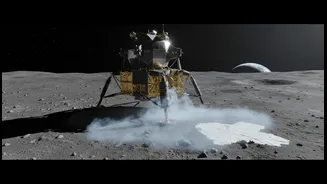
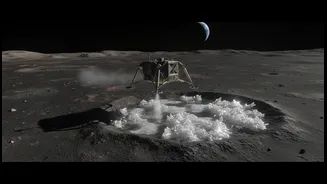
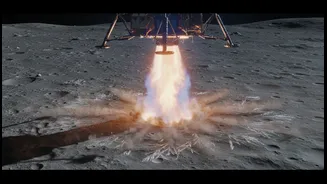
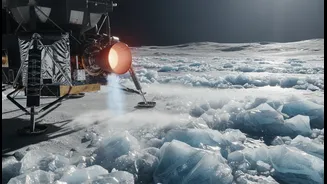
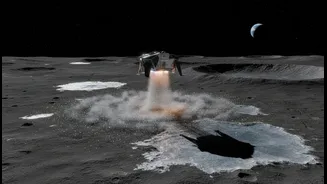
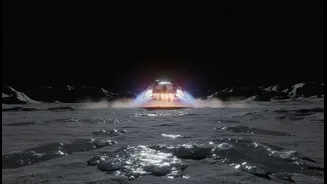
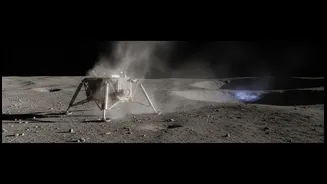
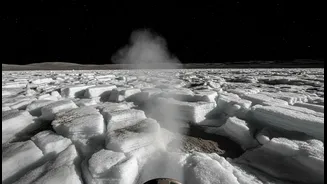
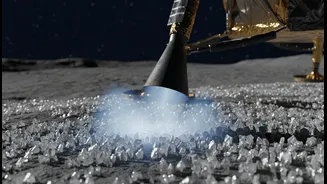
Landing a spacecraft on the Moon is a violent event. With no atmosphere to slow the descent, landers must fire powerful rocket engines until the last moment. These engines blast supersonic jets of hot gas onto the surface, kicking up dust and creating
a temporary, localized atmosphere of exhaust fumes. This has been a known factor since the Apollo missions. The primary components of this exhaust, which can include water, hydrogen, and carbon compounds, don't just disappear. On the airless, low-gravity Moon, they behave in very strange ways. Instead of dispersing as they would on Earth, the gas molecules can travel vast distances.
Methane's Ballistic Journey
While much of the exhaust, like water vapor, is a concern, methane (CH4) presents a unique problem. Recent computer simulations, including one focusing on the European Space Agency's Argonaut mission, have modeled how methane molecules behave after being released from a lander's engine. Because the Moon has virtually no atmosphere to create drag, the molecules are unimpeded. Energized by sunlight, they don't fly off into space but instead perform a series of ballistic hops across the surface, like tiny bouncy balls. As one physicist involved in the research described it, they "just hop around from one point to another."
The Global Migration
This hopping mechanism means that contamination is not a local issue. A single landing near the South Pole can spread methane molecules across the entire lunar surface with surprising speed. Simulations show methane can reach the opposite pole in less than two lunar days. Within about seven Earth months, more than half of the released methane could become trapped in the Moon's coldest regions. Studies estimate that after a South Pole landing, around 42% of the methane will settle near the South Pole, with another 12% migrating all the way to the North Pole.
The Problem with Polar Ice
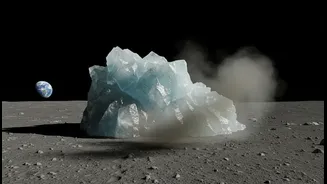
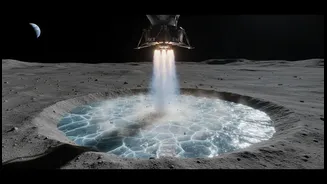
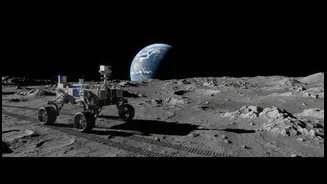
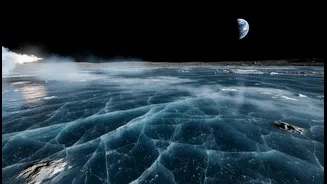
The final destination for this migrating methane is what makes it a critical issue for science. The molecules are drawn to the coldest places on the Moon: the permanently shadowed regions (PSRs) inside craters at the poles. These areas, which haven't seen sunlight in billions of years, act as 'cold traps'. Scientists believe these PSRs hold a priceless scientific record, including ancient water ice and possibly prebiotic organic molecules delivered by comets and asteroids. These deposits could hold clues to the origin of life on Earth. When man-made methane from landers gets trapped in the same icy regions, it can permanently contaminate this pristine record, making it difficult for future instruments, like those on the VIPER rover, to distinguish between naturally occurring volatiles and our own pollution.
Protecting a Priceless Archive
The discovery of this global migration presents a paradox: in our quest to explore the Moon, we risk destroying the very evidence we seek. This is a serious concern for planetary protection officers at agencies like NASA and ESA. Knowing this, mission planners are now considering how to mitigate the impact. Strategies could include selecting colder landing sites to limit how far exhaust molecules can travel, or developing new technologies to reduce lander emissions. Some researchers also want to study whether the exhaust simply settles on top of the ancient ice, leaving the layers below undisturbed. As one ESA official noted, it is not a theoretical problem but a reality that must be addressed as we prepare to go back to the Moon.