

Jupiter's Turbulent Weather
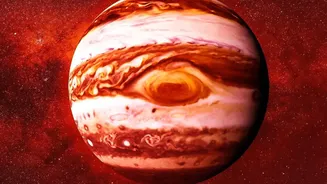
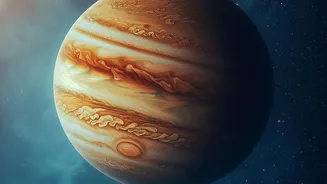
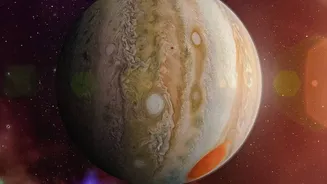
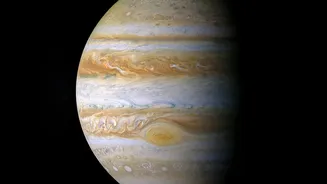
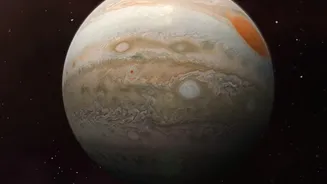
For centuries, astronomers have gazed at Jupiter, mesmerized by its colourful bands and turbulent storms. Unlike Earth, this gas giant has no solid surface to slow down weather systems, allowing them to rage for incredible lengths of time. The most famous
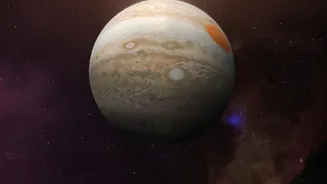
of these is the Great Red Spot, a colossal anticyclonic storm wider than Earth itself, which has been observed for at least 150 years, and possibly much longer. This persistent, high-pressure vortex spins with ferocious intensity, creating a spectacle that has long been a subject of scientific fascination. These giant storms, sometimes poetically called 'cosmic tornados,' are not like terrestrial tornados but are vast, rotating systems embedded within Jupiter's powerful jet streams.
A New Generation of Eyes
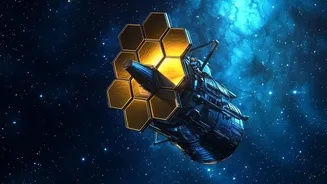
Our understanding of Jupiter has been revolutionized by missions like NASA's Juno spacecraft and the James Webb Space Telescope (JWST). These advanced instruments can peer beneath the planet's cloud tops and capture images in wavelengths of light invisible to the human eye, providing a more complete picture of its atmospheric dynamics. Juno's Microwave Radiometer, for instance, can probe deep into the atmosphere, revealing the structure and movement of the gases below the visible clouds. Meanwhile, the JWST's incredible sensitivity in the infrared spectrum allows scientists to track features and measure wind speeds at different altitudes, revealing previously unseen phenomena like high-altitude jet streams.
The Incredible Shrinking Spot
One of the most startling discoveries from long-term observation is that the Great Red Spot is shrinking. In the late 19th century, the storm was vast enough to swallow two or three Earths side-by-side. Today, it's barely wider than a single Earth. This isn't a new development; astronomers have tracked this contraction for over a century. However, recent, more detailed observations have added new layers to the mystery. As the storm shrinks in width, it appears to be growing taller, stretching higher into the planet's atmosphere. This suggests the storm's dynamics are changing in complex ways, with the vortex becoming more compact but potentially more intense.
Why Is This Happening?
The honest answer is that scientists aren't entirely sure why the Great Red Spot is shrinking. Jupiter's storms are fueled by the planet's internal heat and its powerful, alternating jet streams, which effectively cage the storm and prevent it from dissipating. One theory is that changes in these jet streams or in the way the Great Red Spot absorbs smaller, surrounding storms could be altering its energy balance. Some observations have shown large "flakes" of red material peeling off the storm's edge, suggesting a loss of momentum or mass. It's a complex puzzle involving massive atmospheric forces, and researchers are using sophisticated computer models to simulate the storm's behavior and understand the underlying mechanisms driving this change.
A Glimpse into Planetary Evolution
Studying the evolution of Jupiter's storms does more than just satisfy our curiosity about our largest planetary neighbor. It provides a natural laboratory for understanding atmospheric physics under extreme conditions. The principles that govern weather on Jupiter—a planet driven by internal heat and rapid rotation—help scientists refine their models for how atmospheres work on gas giants throughout the universe. Watching a centuries-old storm change in our lifetime is a rare opportunity to witness planetary-scale evolution in real-time. Whether the Great Red Spot will eventually disappear, like other large storms in Jupiter's past may have, or if it will stabilize at a new, smaller size remains an open question.